Waste Water Treatment and Collection
Waste water treatment and collection is the shared responsibility of the Hampton Roads Sanitation District (HRSD) and the City of Newport News. The city collects wastewater through its gravity sewers and pump stations, and transports this wastewater to the Hampton Roads Sanitation District (HRSD) interceptor system, which in turn, conveys the wastewater to HRSD wastewater treatment plants for processing and treatment prior to discharge into public waters.
Waste Water Treatment
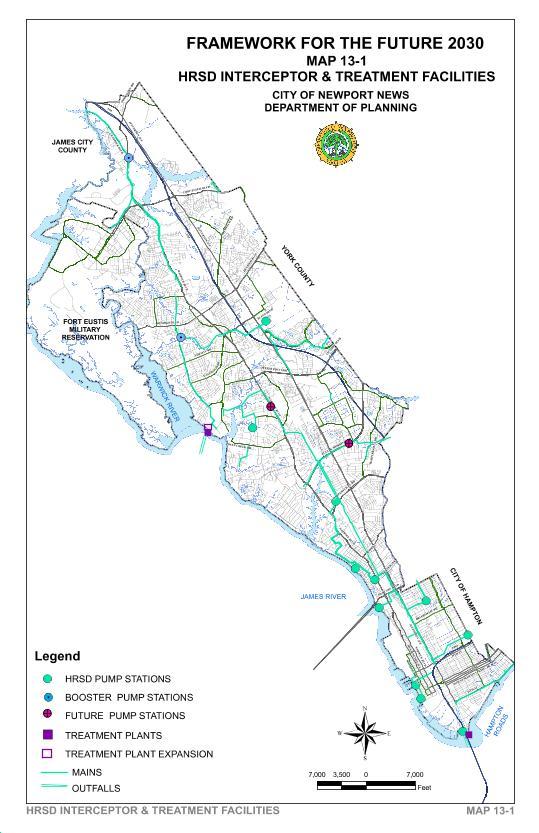
HRSD serves a 672 square mile area of the Peninsula. Map 13-1 shows the location of the HRSD wastewater treatment plants in the City. HRSD owns, operates, and maintains the Interceptor Sewer System, which consists of large gravity sewers, force mains, and pump stations and four waste water treatment plants on the Peninsula (Boat Harbor, James River, Williamsburg, and York River). Each wastewater treatment plant has a Virginia Pollution Discharge Elimination System (VPDES) permit. The pump stations, gravity sewers, and force mains are covered under the treatment plant's VPDES permits.
HRSD does not need more wastewater treatment plants serving the Peninsula. However, HRSD is planning an expansion of the York River Plant to double the capacity to 30 mgd and incorporate state-of-the-art technology to remove nutrients and long-range expansions are planned for the James River and Williamsburg Plants. No expansions are planned for the Boat Harbor Plant. The planned expansions will increase HRSD's total treatment capacity on the Peninsula to 130 mgd, which is sufficient for meeting long-range future demands.
Biosolids, commonly called sludge, are byproducts of wastewater treatment. Biosolids from the Boat Harbor and Williamsburg Plants are incinerated on site. The resulting ash is landfilled or recycled into concrete blocks. Biosolids from the James River Plant and York River Plant are recycled as Nutri-green compost.
Enhanced primary and secondary processes are currently in use to remove phosphorus to permitted levels and to remove nitrogen at all HRSD plants. Future environmental legislation requiring removal of nitrogen and toxins will be expensive and will necessitate an increase in HRSD user fees. HRSD has stated that the enhanced nutrient removal processes being required by new regulations involve tertiary treatment. These new processes will be put in place at the James River, York River and Army base treatment plants by January 2011.
Local Waste Water Collection System
Newport News' wastewater collection system is comprised of 172 pump stations, 40 miles of force mains and approximately 658 miles of wastewater collection lines of varying sizes. The Virginia Department of Environmental Quality (DEQ) and the State Health Department approve the design and installation of all City pump stations, force mains, and collection mains that connect with the HRSD interceptor sewer system.
Portions of the wastewater collection system are in poor condition, allowing groundwater and stormwater to infiltrate into the sanitary sewers. Inflow of stormwater into the wastewater collection system also occurs from submerged manholes, gutter downspout connections, and illegal stormwater connections. Excessive inflow/infiltration (I/I) increased flows that must be transported and treated. Although treatment plants, interceptor systems, and pump stations are designed to handle a small percentage of I/I into the system, excessive rates of I/I can cause overflows at pump stations or sewage backups in households or streets. In some cases, overflows discharge pollutants or untreated sewage into State waters, which violates the VPDES permit at the HRSD wastewater treatment plant.
HRSD and the localities it serves are under a Regional Consent Order, a directive by the Environmental Protection Agency (EPA) through the Virginia DEQ, to establish a set of controls and directives to reduce, if not eliminate all sanitary sewer overflows (SSOs) in the region. In addition to the analysis of the condition of the wastewater collection system, the Regional Consent Order requires the City to study the capacity, maintenance, operations and management of its wastewater operations.
HRSD and the City will identify areas where the City's wastewater collection system has excessive rates of I/I. These areas will be identified and prioritized for corrective action including rehabilitation or replacement of existing wastewater collection lines. The rehabilitation of these collection lines will be the City's responsibility. Abatement projects will be programmed in the Capital Improvements Plan.
The City extends public sewers to areas served by septic systems. The areas receiving public funding are prioritized based on factors, including information on septic tank failures from the Department of Health, Division of Environmental Health, which monitors septic system permits, soil saturation, age of the septic tanks, availability of funds, number of households to be served, etc.
There are homes on septic systems where public sewers have been extended, because City Ordinance requires homes to connect to public sewers if their septic system fails and they are within 250 feet from the public sewer system.
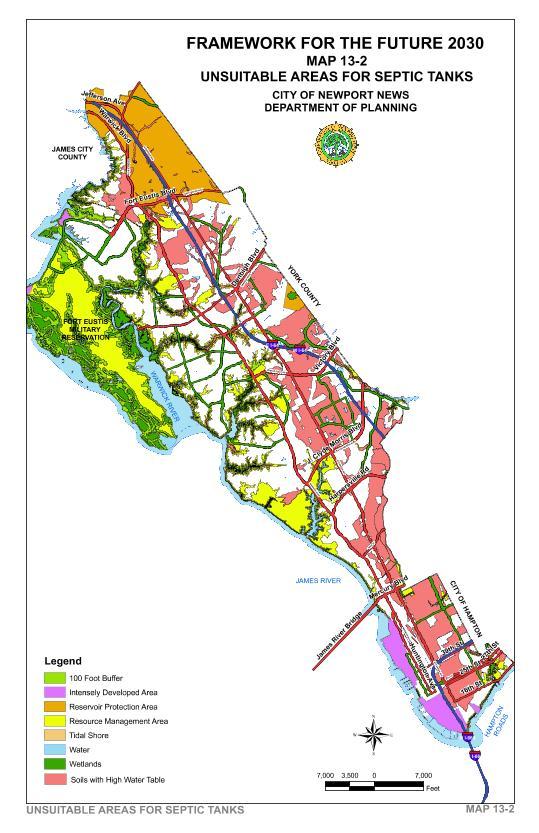
In order to improve the water quality in the City's creeks, rivers and the Chesapeake Bay, all structures, on septic tanks in environmentally sensitive areas, should connect to an available wastewater collection system. Environmentally sensitive areas are: areas with high water tables, Chesapeake Bay Preservation Areas, and the Reservoir Protection Zones, underground water recharge areas, etc. These environmental sensitive areas are shown on Map 13-2.