Housing Goals, Policies, Strategies and Implementation Actions
The long-range planning goals for Housing are:
- Increase home ownership in Newport News.
- Reduce the percentage of public and privately owned assisted rental housing in the city.
- Promote housing in suitable and safe living environments for every Newport News family and citizen.
- Promote a range of housing opportunities meeting the needs of all income groups throughout the city.
- Maintain, protect and revitalize older residential neighborhoods by identifying areas that may need targeted programs to assist with revitalization and educating homeowners about the available programs.
- Redevelop the Downtown and Southeast Community into a desirable mixed-use residential area.
- Encourage developers and utility companies, through incentives, to build "smart houses" and upgrade the existing housing stock using advanced technology in materials, safety, security, energy efficiency, telecommunications, information access and improved quality of life.
The Framework for the Future sets forth the following goals, policies, strategies and implementation for Housing.
GOAL 1
Increase home ownership in Newport News.
POLICY 1.1
Encourage a diverse and balanced housing stock.
Strategy 1.1.1: Encourage well planned, developed and built residential neighborhoods.
IMPLEMENTATION 1.1:
1.1.1: Encourage the development of balanced residential communities. Take into consideration income categories of the city's population, housing density, multiple-family versus single-family, rental versus ownership and support for positive economic and community development goals.
1.1.2: Increase the ratio of home ownership to rental occupancy.
1.1.3: Establish a time frame to achieve the desired ratio.
1.1.4: Periodically reassess the above steps.
1.1.5: Conduct a cost/revenue analysis to determine the fiscal impact of various types and prices of housing units in the city.
POLICY 1.2
Reduce the imbalance of rental units to home ownership.
POLICY 1.3
Reduce the number of mobile home lots in the City.
POLICY 1.4
Raise the average value of the city's single-family homes (single family detached, townhouses and condominiums) to the regional average.
Strategy 1.4.1: Maintain sites for upper income housing.
IMPLEMENTATION 1.4:
1.4.1: Encourage the development of sites to consist of upper and middle income housing.
GOAL 2
Reduce the percentage of public and privately owned assisted rental housing in the city.
POLICY 2.1
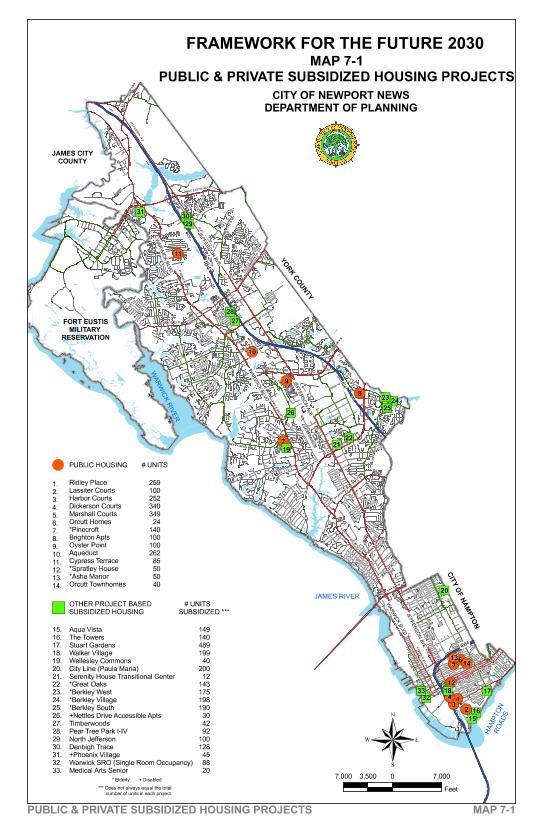
Place a ceiling on the percentage of public and privately owned assisted rental housing complexes in the city at 9.75%; and, allow an additional 1% to provide additional assisted housing for elderly and handicapped and other special needs populations on the NNRHA's waiting list.
Strategy 2.1.1: The total percentage of public and privately owned assisted rental housing in the city shall be less than 125% of the Peninsula's regional percentage (7.8%) which computed to 9.75% in 2006.
Strategy 2.1.2: Provide tenant based or project based Section 8 assistance for special needs populations (e.g. the elderly, disabled and family unification programs).
IMPLEMENTATION 2.1:
2.1.1: Phase out project based Section 8 housing in the city and replace units eliminated with tenant based Section 8 certificates or vouchers.
2.1.2: Authorize the City Manager to annually approve up to 50 new tenant based Section 8 certificates and vouchers or project based assistance (with no more than 25 per application) for special populations (e.g. elderly, disabled and family unification programs).
POLICY 2.2
Distribute public and assisted housing in small concentrations in neighborhoods to minimize their impact.
Strategy 2.2.1: Reduce the size of newly acquired publicly owned or subsidized family housing projects to small clusters which can blend into the community, instead of building large projects. Such projects for the elderly should be limited to 50 units.
Strategy 2.2.2: Minimize, through the attrition of units, the amount of public and assisted housing.
IMPLEMENTATION 2.2:
2.2.1: Inventory all assisted and public housing units. As these units deteriorate and are removed from Planning District I, relocate new units in other areas of the city.
2.2.2: Regularly inspect all project based Section 8 units to insure they are well maintained.
POLICY 2.3
Develop standards to minimize impacts of group homes on the surrounding community and distribute group homes, such as shelters, halfway houses and substance abuse rehabilitation centers, throughout the city.
Strategy 2.3.1: Closely regulate group homes and the conversion of homes to group homes in single family residential districts. Require that these homes remain compatible with surrounding neighborhoods and are licensed.
Strategy 2.3.2: Encourage the development of higher quality, affordable housing for the elderly.
Strategy 2.3.3: Evaluate special housing needs for single men and women such as single room occupancy and dormitories or congregate housing.
Strategy 2.3.4: Locate group homes in stable and safe environments in proximity to community facilities and services.
IMPLEMENTATION 2.3:
2.3.1: Develop a clear definition of the phrase "housekeeping unit" as part of the definition of family in the Zoning Ordinance.
2.3.2: Codes Compliance should develop a Nuisance Ordinance that contains a cumulative check list for identifying nuisances as well as corrective enforcement actions.
POLICY 2.4
Encourage a "Fair-Share (subsidized) Housing" policy with surrounding municipalities.
Strategy 2.4.1: Develop a "Fair-Share (subsidized) Housing" plan with surrounding municipalities.
IMPLEMENTATION 2.4:
2.4.1: The Hampton Roads Planning District Commission should develop a "Fair-Share (subsidized) Housing" plan for the region.
POLICY 2.5
Disperse tax credit financed housing.
GOAL 3
Promote housing in suitable and safe living environments for every Newport News family and citizen.
POLICY 3.1
Promote social and economic integration and discourage racial segregation of neighborhoods.
Strategy 3.1.1: Assess the economic and social need throughout the city and promote a more social and economic housing mix by providing area schools, training opportunities, jobs and community facilities. (See also Chapter 2, Economic Development.)
Strategy 3.1.2: Provide home ownership opportunities for middle-income buyers throughout the City.
IMPLEMENTATION 3.1:
3.1.1: The newly created Department of Housing in conjunction with a housing task force should study and evaluate the housing needs of the city and devise a plan that addresses those needs.
POLICY 3.2
Assist in providing short-term help, in the form of shelters, for families needing emergency shelter.
IMPLEMENTATION 3.2:
3.2.1: Seek funding to convert available buildings into single-room occupancy dwellings for low-income single persons and emergency shelters.
3.2.2: Support private non-profit sector efforts to convert available buildings into single-room occupancy dwellings and emergency shelters.
POLICY 3.3
Encourage, through home ownership and maintenance programs, individual ownership of low cost housing by low-income residents.
Strategy 3.3.1: Foster the concept of public housing residents forming home buyers clubs.
Strategy 3.3.2: Foster the concept of home ownership apprenticeship programs for tenants of public and federally subsidized low income properties.
Strategy 3.3.3: Encourage the use of vacant and/or previously foreclosed houses as low income housing stock for new buyers.
Strategy 3.3.4: Support, through policy and in-kind contributions, the Habitat for Humanity housing initiatives.
Strategy 3.3.5: The City, with the NNRHA, should continue and expand the program to educate new and existing homeowners about property repair and maintenance.
Strategy 3.3.6: Continue and expand the provision of tax credits and low interest loans for the purchase and repair of residences outside of target and redevelopment areas.
Strategy 3.3.7: Institute a program of non-financial incentives and requirements, such as awards and recognitions for public housing residents to maintain their homes and yards in order to encourage pride and enforce standards.
Strategy 3.3.8: Institute a program of incentives, for middle-income owner occupants, to renovate their homes.
IMPLEMENTATION 3.3:
3.3.1: Assist public housing tenants with technical assistance from the NNRHA in forming home buyer clubs; and educate them regarding home ownership programs and opportunities.
3.3.2: Seek additional funding, through grants, to allow for the purchase of previously foreclosed residential properties.
POLICY 3.4
Minimize the displacement of residents and assist in the relocation of low and moderate-income tenants, as defined by the U. S. Department of Housing and Urban Development, when rental housing is converted to condominiums or mobile home park property is redeveloped.
Strategy 3.4.1: Developers should be required to give tenants the right of first refusal when rental units are converted to condominiums.
Implementation 3.4:
3.4.1: Encourage owners of rental units to give tenants the right of first refusal when rental units are converted to condominiums.
POLICY 3.5
Enforce the City Code and develop standards and codes for future housing construction to be hurricane resistant.
GOAL 4
Promote a range of housing opportunities meeting the needs of all income groups throughout the city.
POLICY 4.1
Strive to bring down housing costs for first time home buyers.
Strategy 4.1.1: Employ innovative/creative financing techniques such as long mortgage terms, interest buy-down and tax breaks for mortgage holders to make home ownership possible for lower income households.
Strategy 4.1.2: Provide attractive, single family residential housing throughout the city that would attract first time home buyers.
Strategy 4.1.3: Use state and federal resources, such as Virginia Housing and Development Authority (VHDA), to assist with first-time home ownership programs.
IMPLEMENTATION 4.1:
4.1.1: Establish a revolving loan program through the Newport News Redevelopment and Housing Authority for first time home buyers.
4.1.2: Publicize, through advertisements in city departments, the availability of the low interest loans from the Virginia Housing Development Authority and the Homebuilder and HOME Place Programs of the NNRHA for first time home buyers.
4.1.3: Continue to finance the HOME Place Program, which allows low income first time home buyers to purchase a substandard single family home at minimal cost and receive a low interest loan for rehabilitation of the home.
4.1.4: Establish a housing trust fund in Newport News to promote home ownership and support the creation of a housing trust fund at the state level.
4.1.5: Continue to expand the Homebuilder Program which allows low and moderate income first-time home buyers to purchase newly constructed homes.
4.1.6: Support the Newport News Home Ownership Fair as an annual event as part of National Home Ownership Week.
POLICY 4.2
Encourage a variety of housing types and designs within various price ranges.
Strategy 4.2.1: Construct mid-rise senior citizen homes, assisted living facilities and nursing homes where feasible.
Strategy 4.2.2: Expand the single-family residential zone to allow accessory apartments for extended families under certain conditions.
Strategy 4.2.3: Encourage developers, through density bonuses and other incentives, to include affordable middle and low income housing in large projects.
Strategy 4.2.4: Involve all organizations in the city that handle low income housing issues and/or provide low income housing in developing and implementing low income housing solutions.
IMPLEMENTATION 4.2:
4.2.1: Amend the Zoning Ordinance to allow homeowners in single family zoning districts to apply for conditional use permits for accessory apartments for extended family members if specific conditions, as stated in the Ordinance, are met. Accessory apartments, proposed as part of neo-traditional developments, should be allowed as a matter of right.
4.2.2: Encourage the housing industry to explore alternative construction techniques such as building modular homes clustering units and smart houses.
POLICY 4.3
Encourage a mix of housing types through more flexible zoning and site planning practices.
POLICY 4.4
Evaluate the city’s housing stock annually to ensure that it meets current housing needs.
Strategy 4.4.1: Conduct a public survey of housing needs of residents throughout the city.
Strategy 4.4.2: Make the community aware of the housing needs through advertisements and public meetings.
Strategy 4.4.3: Analyze the most current population and housing data to determine the balance of housing and housing needs for all income levels.
Strategy 4.4.4: Use the most current population and housing data to evaluate the need for elderly housing and extended family alternatives.
Strategy 4.4.5: Evaluate the need for special needs housing in the city.
IMPLEMENTATION 4.4:
4.4.1: Create a housing task force consisting of citizens and professionals that would assist the Department of Housing to identify housing needs and recommend housing policies for the city.
4.4.2: Analyze the most current population and housing data to determine the balance of housing and housing needs for all income levels and the elderly.
4.4.3: Conduct a survey in order to gather citizen concerns on housing needs.
4.4.4: Create a Department of Housing to be responsible for tracking and evaluating housing trends and programs citywide.
GOAL 5
Maintain, protect and revitalize older residential neighborhoods by identifying areas that may need targeted programs to assist with revitalization and educating homeowners about the available programs.
POLICY 5.1
Promote development and redevelopment in blighted and declining areas of the city.
Strategy 5.1.1: Identify and assess tax incentives that would encourage property owners to maintain and improve property in blighted areas of the city.
Strategy 5.1.2: Support neighborhood cleanup and neighborhood improvement efforts by the citizens. (See also Chapter 8, Public Safety, Goal 8.)
Strategy 5.1.3: Adopt and enforce housing codes for all housing units, especially for rental housing units that contribute to blight.
Strategy 5.1.4: Encourage neighborhood revitalization through the development of concentrated home ownership opportunities through new construction and housing rehabilitation.
IMPLEMENTATION 5.1:
5.1.1: Purchase abandoned and boarded up structures using Community Development Block Grant (CDBG) and other available grant funds when supported by the city's redevelopment plan.
5.1.2: Fund and hire additional code inspector positions in the Department of Codes Compliance and Department of Public Works, Solid Waste Division, increase the number of inspectors and require vigorous enforcement of the code. Conduct scheduled neighborhood inspections on a regular basis.
5.1.3: Require responsible city departments, especially in the older areas, to maintain infrastructure, community facilities and landscaping throughout the city.
5.1.4: Establish conservation districts that would include a design review process for infill development.
5.1.5: Continue to fund, through CDBG and other sources, a program to acquire dilapidated and vacant houses on 25 foot wide lots and donate or sell the land after demolition to the adjoining property owners or combine lots into larger lots that can be developed for single-family dwellings.
5.1.6: Expand the Adopt-A-Block initiative that promotes affordable home ownership in a concentrated manner through new construction and housing rehabilitation thereby revitalizing older city neighborhoods.
5.1.7: Explore Code enforcement by making non-public safety violations civil, not criminal, infractions.
POLICY 5.2
Invest public funds and seek private funding in the redevelopment of deteriorated areas of the city to maintain a quality of life in the city.
Strategy 5.2.1: Older neighborhoods with deteriorated housing should receive high priority for housing and community development assistance to upgrade homes and neighborhoods.
Strategy 5.2.2: Promote private redevelopment efforts by offering technical assistance and loan guarantees.
Strategy 5.2.3: Continue to fund the revolving loan program with public funding to help low and moderate income families maintain their homes and encourage the rehabilitation of existing housing units that have fallen into disrepair or are substandard.
Strategy 5.2.4: In conjunction with redevelopment projects, relocate and provide relocation assistance to residents living in mobile homes.
IMPLEMENTATION 5.2:
5.2.1: Prepare redevelopment plans for the older, deteriorated areas of the city and seek grant funds and earmark funds in the Capital Improvements Program for redevelopment efforts identified in the plan.
5.2.2: Offer technical assistance and funding to private developers seeking to redevelop areas that have been identified in redevelopment plans through the city's Department of Housing, Planning and the Newport News Redevelopment and Housing Authority.
5.2.3: Continue to fund the Home Care Program as a revolving loan program, through the Newport News HOME Program to assist low and moderate income families with housing rehabilitation loans.
5.2.4: Seek ways to redevelop the area on the west side of Jefferson Avenue from 39th Street to Briarfield Road.
POLICY 5.3
Continue and expand existing housing rehabilitation programs through departmental and agency coordination.
Strategy 5.3.1: The Newport News Redevelopment and Housing and the Department of Housing in conjunction with other appropriate city departments should continue to work to improve the dissemination of information concerning housing rehabilitation programs.
Strategy 5.3.2: Continue the weatherization program for low income homeowners and expand other housing assistance programs that assist residents with property maintenance.
Strategy 5.3.3: Continue the housing rehabilitation program for emergency repairs and handicapped accessibility for the elderly and handicapped low and moderate-income homeowners.
IMPLEMENTATION 5.3:
5.3.1: Disseminate information concerning housing rehabilitation programs through code inspectors with the Department of Codes Compliance and other city departments.(See also Chapter 8, Public Safety, Goal 8)
5.3.2: Seek additional grant funding to expand the weatherization program, the housing rehabilitation program for emergency repairs, the handicapped accessibility program and other housing assistance programs.
POLICY 5.4
Institute and implement neighborhood conservation districts in older neighborhoods to preserve the character and integrity of the neighborhood.
Strategy 5.4.1: Develop standards for neighborhood conservation districts that maintain the contextual character of the neighborhood.
Strategy 5.4.2: Support a design review process to achieve quality and compatibility of new development in neighborhood conservation districts.
Strategy 5.4.3: Provide incentives to homeowners within neighborhood conservation districts to maintain, restore and beautify their homes.
Strategy 5.4.4: Develop and implement programs focused on conservation and revitalization of neighborhoods.
IMPLEMENTATION 5.4:
5.4.1: Amend the Zoning Ordinance to include new regulations for neighborhood conservation districts.
5.4.2: Develop design standards for neighborhood conservation districts that will require new development to conform to the contextual character of the neighborhood.
5.4.3: Institute, by Ordinance, a design review process for neighborhood conservation districts.
POLICY 5.5
Support neighborhoods that currently contain a concentration of publicly owned and federally subsidized housing by providing increased community facilities, services, amenities and infrastructure maintenance.
Strategy 5.5.1: Fund, through the Capital Improvements Program, infrastructure improvements, construction of community facilities and other amenities in areas of the city with economically disadvantaged populations.
GOAL 6
Redevelop the Downtown and Southeast Community into a desirable mixed-use residential area.
POLICY 6.1
Support housing construction in the Downtown area through the provision of essential public services and encourage the development of community facilities, retail, entertainment and cultural facilities.
Strategy 6.1.1: Provide housing as recommended by the LDR Maritime Center Plan.
IMPLEMENTATION 6.1:
6.1.1: Continue to implement the LDR Maritime Center Plan.
GOAL 7
Encourage developers and utility companies, through incentives, to build "smart houses" and upgrade the existing housing stock using advanced technology in materials, safety, security, energy efficiency, telecommunications, information access and improved quality of life.
POLICY 7.1
Provide information to the building community encouraging the use of green building techniques and energy star guidelines.
IMPLEMENTATION 7.1:
7.1.1: Provide flexibility within the city ordinances to allow the use of green building materials and techniques as prescribed by the U.S. Green Building Council.
7.1.2: Establish an incentive program that would assist individual property owners, builders, developers and utility companies with the implementation of green building techniques.