
Health Care
Access to health care has been improved for pregnant women, infants and children due to expanded Medicaid eligibility and the main streaming of Medicaid recipients into private care through Health Maintenance Organizations (HMOs). Two populations continue to need assistance in obtaining medical care. The first group is indigent adults who have multiple chronic diseases requiring complex medical management and many expensive drugs. The poor suffer disproportionately from cancer, heart disease, diabetes and AIDS. The second group is poor women, just above medical eligibility who seek family planning services. Access to health care will continue to pose a problem for many families. In Newport News, approximately 15.6 percent of the population and 13.5 percent of the population under the age of 18 have no health care coverage. Access to dental care is also limited. The “Smart Smiles” program addresses the needs of those who have no dental health insurance. Local dentists volunteer their time to assist those in need.
AIDS, HIV and Sexually Transmitted Infections
During 2004, 50 residents of Newport News were diagnosed with HIV infection and 28 were diagnosed with AIDS. The rate of new HIV diagnoses in 2004 was 27 per 100,000 population, which was the same as the rate in 2000. New diagnoses of AIDS had declined from a rate of 22 per 100,000 in 2000 to a rate of 15 per 100,000 in 2004.
While gonorrhea diagnoses declined from 511 per 100,000 population in 2000 to 462 per 100,000 in 2004, chlamydia was diagnosed more frequently (745 per 100,000 in 2004 compared to 476 per 100,000 in 2000). For both diseases, the rates for 2004 in Newport News were higher than the rates in other cities in the Hampton Roads region. In 2004, Newport News experienced an increase in the number of people diagnosed with early syphilis to 17 (9 per 100,000): from 2000-2003, the annual number of new diagnoses had ranged from 0 to 7 per year.
Smoking
In 2005, the Centers for Disease Control and Prevention estimate approximately 20.9 percent of adults in the United States were current cigarette smokers, the same percentage as in 2004, suggesting that the eight year decline in smoking prevalence among adults in the United States might be slowing. Current smokers are defined as persons who reported smoking more than 100 cigarettes during their lifetime and at the time of the survey reported smoking every day or some days. The Centers for Disease Control conducted a Youth Risk Behavior Study in which they found 23 percent of high school students smoked in 2005, up from 21.9 percent in 2003. The Virginia Center for Healthy Communities reports 23.8 percent of adult residents of Newport News smoke.
The lack of progress in reducing tobacco use and increasing cessation attempts among U.S. adults underscores the need for increasing measures to establish sustained, comprehensive, evidence-based tobacco-control programs that address both initiation and cessation.
Chronic Diseases
The Virginia Center for Healthy Communities used the Behavioral Risk Factor Surveillance System methodology to provide estimates of various health behaviors in 2004. Among adult residents of Newport News, 24.5 percent reported that they had no exercise in the past 30 days; 75 percent had less than five servings per day of fruits and vegetables; 23.8 percent smoked; 15.3 percent were at risk for binge drinking of alcohol; and 59.3 percent were overweight or obese.
Among adults over age 18 in Newport News, 7.5 percent reported that a doctor told them that they had diabetes; 24.6 percent were told they had high blood pressure; 23.2 percent were told they had high cholesterol; 13.7 percent were told they had asthma; and 25.2 percent were told they had arthritis. In addition, 13.5 percent of adults in Newport News reported that they had fair or poor health status and 16.1 percent reported that they had limitations due to their health.
Access to health care was a problem for some residents of Newport News: 15.2 percent reported that they had no health coverage and 13.7 percent could not see a doctor due to cost. Over 22 percent reported that they had no dental care in the past two years.
Within the city, there are disparities in the burden of chronic diseases. In 2005, the Peninsula Health District conducted
a community health assessment of the Southeast Community. The community health assessment focused on identifying needs and
perceptions on 1) prevention and control of chronic diseases, 2) education of the public about chronic disease prevention
and 3) improving access to basic chronic disease medical management and access to affordable medications. These areas were
priorities set by the U.S. Healthy People 2010 initiative and the Virginia Department of Health. Data sources for the health assessment included: publicly available demographic
data; mortality data provided by the Virginia Center for Health Statistics; and data for emergency department visits and hospital
admissions/ discharges provided by local hospitals. In addition, public health professionals conducted individual interviews
with approximately fifty key leaders; held focus groups with six resident/key leader groups; and surveyed 368 residents using
a sidewalk survey instrument.
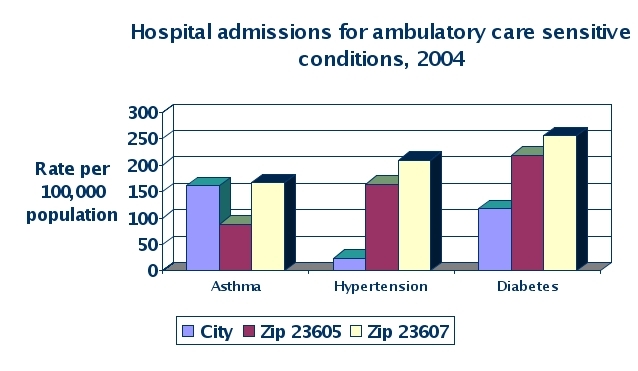
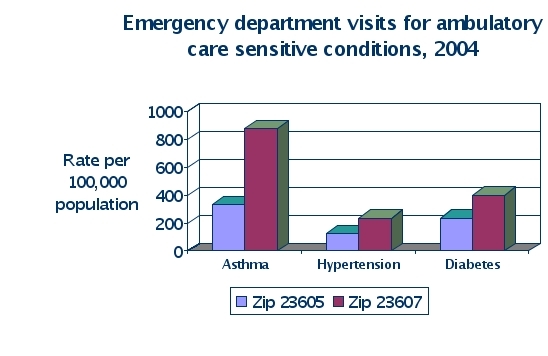
The residents of the Southeast Community are at increased risk for hospitalization and death from chronic diseases. The residents of zip code 23607 experience higher rates of emergency room visits and hospitalization for asthma, diabetes, and hypertension, than the residents of the neighboring zip code 23605, the City and the State. The residents of zip code 23607 have a rate of 250 hospitalizations per 100,000 population per year for diabetes mellitus which is twice the rate experienced by any other area of the city. The death rates for residents of the Southeast Community exceed the rates for the city overall and for the State for heart disease, malignant neoplasms, cerebrovascular disease, and diabetes.
The survey of 368 residents documented perceptions that diabetes, stroke, and high blood pressure were significant problems for the community. Poor eating habits, lack of physical activity or exercise, and tobacco and alcohol use were perceived as important unhealthy behaviors in their community. Respondents were not aware of any coordinated efforts that focused on chronic disease issues among medically uninsured/underserved adults.
The community needs assessment confirmed that residents of the Southeast Community have a great deal of pride in and ownership of their community and its challenges. They will be most interested, supportive and participatory in efforts to improve the overall health of their community.
With the encouragement of City government, the Peninsula Health District is undertaking an initiative to address the burden of chronic disease in this community by directing efforts toward improved prevention and control of diabetes, cardiovascular disease and asthma. Dedicated health district staff will work with residents of the Southeast Community, key collaborators, and other existing community groups to establish a community health task force to plan for and advocate for efforts to lift the burden of chronic illnesses. Subsequent activities will develop and implement community-based programs for: chronic disease awareness, screening, and referral for care; improvement in self-care for persons with chronic diseases; and life-style change to prevent and/or delay the onset of chronic diseases.