
Regional Issues
Because the water in oceans, rivers and creeks and the air in the atmosphere are seldom stationary, the pollution problems associated with each are regional in nature. Animal and plant species are not stationary. They migrate through various means. To help solve regional issues, Newport News meets regularly with the thirteen jurisdictions in Hampton Roads to discuss climate, air and water quality issues.
Regional Climate Change Issues
Climate changes affect the height of sea level, global temperatures and precipitation, which, in turn, impact marine and terrestrial life and their habitats. "Coastal lands on the Peninsula, at or below seven feet mean sea level, are particularly at risk due to sea level rise in the long term." (16) This will affect land in the 100-year floodplain. Because of the rise in sea level, the area covered by floodwaters will increase during significant rainfalls and tidal surges from hurricanes and nor'easters.
In response to the Kyoto Protocol regarding climate change the U.S. Conference of Mayors developed a Climate Protection Agreement that the Mayor of Newport News signed in January 2007. The agreement can be viewed at:
http://usmayors.org/climateprotection/agreement.htm
The agreement expects communities that sign the agreement to strive to meet or exceed the Kyoto Protocol targets for reducing global warming pollution.
In September 2007, the State of Virginia released the Virginia Energy Plan, which sets a goal to reduce greenhouse gas emissions by 30 percent by 2025. In late 2007, the Governor's office established the Commission on Climate Change. "The commission is charged with preparing a Climate Change Action Plan that will :
- Inventory the amount of and contributors to Virginia's greenhouse gas emissions, and projections through 2025.
- Evaluate expected impacts of climate change on Virginia's natural resources, the health of its citizens, and the economy, including the industries of agriculture, forestry, tourism and insurance.
- Identity what Virginia needs to do to prepare for the likely consequences of climate change,
- Identify the actions (beyond those identified in the Energy Plan) that need to be taken to achieve the 30% reduction goal,
- Identify climate change approaches being pursued by other states, regions and the federal government." (17)
Regional Air Quality Issues
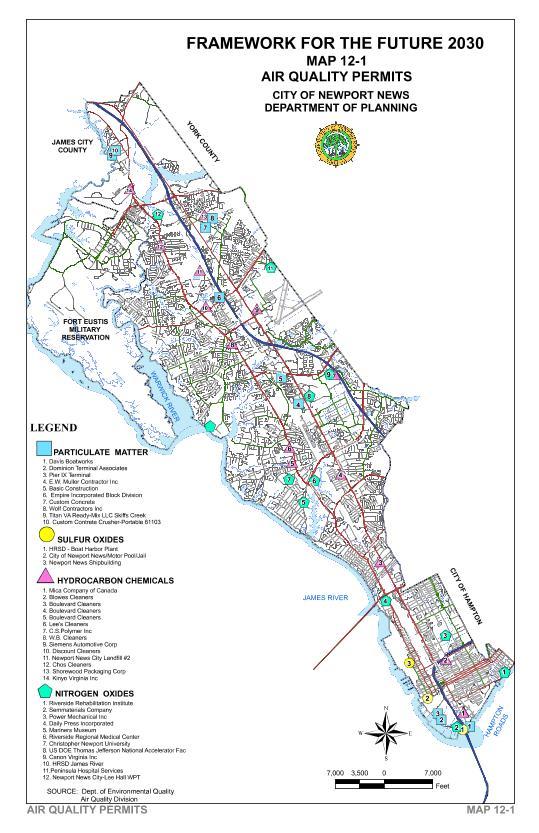
Ambient air is the the atmosphere outside buildings that the general public has access to. Ambient air quality is evaluated by measuring pollutants for which the Environmental Protection Agency (EPA) has established air quality standards. These standards are based on health studies on the effects of pollutants on the portion of the population affected by the pollutant and adding a margin of safety. Stationary air pollution sources in Newport News are identified on Map 12-1.
Ozone
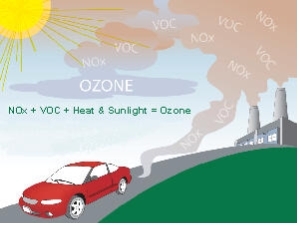
Figure 12-1 illustrates the formation of ozone which causes health problems for certain sensitive individuals which have asthma, and pulmonary conditions, etc.
Since 1983, the Hampton Roads Metropolitan Statistical Area (MSA), which includes the City of Newport News, has been monitored for surface ozone. On June 26, 1997, the EPA declared the region in attainment for ozone for the 1-hour standard, which has a standard acceptable level of 0.12 parts per million (ppm) average for one hour. On June 15, 2004, EPA redesignated Hampton Roads as a marginal non-attainment area under the new ozone standard of 0.08 part per million (ppm) averaged over an 8-hour period.
| Year | Suffolk (TRC)
(in ppb) |
Hampton 179-C
(in ppb) |
Suffolk 183-E (TCC)
(in ppb) |
|---|---|---|---|
| 2004 | 0
(75 average) |
1
(74 average) |
1
(74 average) |
| 2005 | 0
(78 average) |
0
(78 average) |
1
(77 average) |
| 2006 | 0 | 0 | 2 |
| 2007 | 0 | 2 | 2 |
An exceedence must be more than 84 parts per billion. As reflected in Table 12-1, the Hampton Roads region had exceedences once in 2005, twice in 2004 and 2006 and four times in 2007. Good weather, reformulated fuels and newer cars have improved the quality of the air in the region. June 1, 2007, EPA approved re-designation of the region as a “Maintenance Area” for Ozone.
On March 12, 2008, EPA approved a new ozone standard of 75 parts per billion for an 8-hour period. The regions ozone levels in the last three years have exceeded this new standard. As of June 2008, the region already experienced eight exceedences. It is likely the region will be designated non-attainment.
Particulate Matter
“Particulate matter means any airborne finely divided solid or liquid with an aerodynamic diameter smaller than 100 micrometers.” (18) Smoke containing particulate matter is generated during open burning. Open burning is regulated through the State Air Pollution Control Board's Regulations for the Control and Abatement of Air Pollution. Rule 4-40 (19) of these regulations is intended to limit the effects of open burning on the surrounding areas by limiting the types of materials that may be burned and by restricting the location of burning and distance from neighbors where burning may take place. Usually, the effects of open burning are localized and have no major impact on overall air quality.
Newport News regulates open burning and requires people to obtain a permit from the City’s Fire Marshall. Most open burning permits are for land clearing of brush, stumps, treetops, etc.
In December 2006, the EPA changed standards for particulates. For fine particles the level of the 24-hour PM2.5 standard changes from 65 micrograms per cubic meter (ug/m3) to 35 ug/m3. The level of the annual standard at 15 ug/m3 was retained. This standard became effective in December of 2006 and DEQ must recommend areas of attainment and non-attainment to EPA by December 2007. The designations for nonattainment do not include the Hampton Roads region.
Hydrocarbons
Hydrocarbons are organic compounds composed of carbon and hydrogen atoms that primarily come from fossil fuels including coal, petroleum, and natural gas. Industry contributes to the amount of hydrocarbon in the environment by incomplete combustion when burning fossil fuels. Automobiles are responsible for approximately twenty percent of all hydrocarbon emissions.
The Virginia Air Pollution Control Board's Regulations' Rule 4-41 (20) regulates mobile sources, which are defined as “any vehicle (automobile, truck, bus, etc.) or other land craft; airplane or other aircraft; locomotive or other rail vehicle; ship, boat or water craft, which emits or may emit and air pollutant”. (21) Reducing Single Occupancy Vehicle (SOV) miles driven, increasing carpools and mass transit, will help reduce the amount of hydrocarbons caused by motor vehicles.
Volatile Organic Compounds
Volatile organic compounds (VOCs) in the atmosphere contribute to ozone and smog formation. Some volatile organic compounds are both toxic and cancer causing making exposure to VOC’s in large quantities or over long periods of time unsafe.
Industrial and commercial applications, operations and systems which emit volatile organic compounds include manufacturing of pharmaceutical products and rubber tires, petroleum refinery, solvent metal cleaning operations, volatile organic compound storage and transfer operations, all types of coating applications, graphic arts printing processes, petroleum liquid storage and transfer operations, dry cleaning systems, and asphalt paving operations. Volatile Organic compounds in the Hampton Roads Area are regulated through Virginia's Regulations for the Control and Abatement of Air Pollution Rule 4-24 (22), 4-36 (23), 4-37 (24), and 4-53 (25).
Oil-based paints emit volatile organic compounds (VOCs) into the atmosphere during the drying process through evaporation. In addition, equipment is cleaned with solvents, which also emit VOCs into the atmosphere. VOCs indirectly contribute to the surface ozone problem. Therefore, discouraging the use of oil-based paint would be a positive contribution to the surface ozone problem. Consumer products are not regulated by DEQ in the Hampton Roads area as they are in Northern Virginia. However, the Hampton Roads area is in a VOCs Emissions Control Area that coincides with the boundaries of the Ozone non-attainment designation area and proposed Ozone maintenance area.
Regional Water Quality Issues
Nutrients, toxic substances and sediments entering the local creeks, rivers and the Chesapeake Bay, cause regional water quality issues. Controlling pollution at their sources is discussed in this chapter. Because creeks, tributaries and watersheds cross jurisdictional boundaries, the approach and solutions to these issues should be regionally developed and applied.
The EPA and Department of Environmental Quality (DEQ) regulate the use of Tributylin (TBT) by the local shipyards. TBT is a concern when sand blasting and washing vessels that were originally treated with TBT. Shipyards are either banned from using TBT, or have an annual load limit of 5 grams per year or a concentration limit of .72 micrograms per liter. If a banned facility chooses to use TBT, they are required to notify DEQ and modify their permit.
DEQ and the Virginia Health Department (VHD) regulate Kepone in the James River. Kepone is a toxic pesticide that was discharged illegally from a plant in Hopewell, Virginia between 1966 to 1974. State officials closed the plant in 1975 and Allied Chemical who owned the plant was fined. Kepone settles in the soils in the bed of the rivers and creeks. It is an issue when dredging channels in contaminated areas.
DEQ and VHD close beaches in Newport News and other localities because of high Fecal Coliform counts that resulted in an ongoing Total Maximum Daily Load (TMDL) study for Fecal Coliform for the Warwick River, James River, and Deep Creek. The implementation plan will be developed in FY 2010 or beyond.
The James River Reserve fleet created in 1925 as part of the National Defense Reserve Fleet, is located in the James River between Fort Eustis and Isle of Wight County beside the main shipping channel. The ships are in various levels of deterioration. They contain fuel, asbestos, and cancer causing polychlorinated biphenyls or PCBs. If a ship became loose during a bad storm, the oil and other hazardous materials could contaminate the James River and its tributaries. The state of Virginia and the Hampton Roads Region urge the U.S. Maritime Administration and local congressional representatives to dispose of the James River Reserve Fleet to eliminate its environmental threat.
Two other examples of regional efforts to improve water quality are the Chesapeake Bay Nutrient and Sediment Reduction Tributary Strategy for the James River, Lynnhaven and Poquoson Coastal Basins dated March 2005 and the Municipal Separate Storm Sewer System (MS4) Program for Newport News and the other urban localities in the Hampton Roads Area. More discussion on these programs is included later in the chapter.
Regional Natural Resource Issues
Regional natural resource issues concern the protection of non-tidal and tidal wetlands, the use of the flood plains and steep slopes, the protection of rare, threatened or endangered species, and shoreline erosion. These issues, regulated by the state and localities are discussed further within this chapter.
However, a problem over which there is no control is the migration of non-native plant and animal species in the ballast water of foreign merchant ships, freighters, and navy vessels which frequent our ports. These foreign species can upset the balance in the local ecosystem. One example is the Veined Rapa Whelk that was discovered in the region’s waters in the summer of 1998. Distribution maps show Veined Rapa Whelks ranging from Tangier Island, to the Bay Bridge tunnel, and to the just above the James River Bridge. The Virginia Institute of Marine Science (VIMS) is studying the Veined Rapa Whelk life cycle and its impact on the local ecosystem.
- Peninsula Multi-Jurisdictional Natural Hazards Mitigation Plan, Disaster Mitigation Act of 2000, Peninsula Hazard Mitigation Planning Committee, January 2006, page 51-52.
- Timothy M. Kaine, Governor of Virginia, Executive Order 59 (2007)
- State Air Pollution Control Board, Regulations for the Control and Abatement of Air Pollution, Part I, General Definitions, March 17, 1972, page. 9.
- State Air Pollution Control Board, Regulations for the Control and Abatement of Air Pollution, Part II, Article 40. Emission standards for Open Burning, amended October 18, 2006, pages 1-19
- State Air Pollution Control Board, Regulations for the Control and Abatement of Air Pollution, Part II, Article 41. Emission Standards for Mobile Sources, amended August 1, 1991, pages 1-4.
- State Air Pollution Control Board, Regulations for the Control and Abatement of Air pollution, Part IV, Emission Standards for Mobile Sources, March 17, 1972, page 267.
- State Air Pollution Control Board, Regulations for the Control and Abatement of Air Pollution, Part II. Article24. Emission Standards for Solvent Metal Cleaning Operations Using Non-Halogenated Solvents, amended March 24, 2004, Pages 1-10.
- State Air Pollution Control Board, Regulations for the Control and Abatement of Air Pollution, Part II. Article36. Emission Standards for Flexographic, Packaging Rotogravure, and Publication Rotogravure Printing lines, amended October 4, 2006, Pages 1-7.
- State Air Pollution Control Board, Regulations for the Control and Abatement of Air Pollution, Part II. Article37. Emission Standards for Petroleum Liquid Storage and Transfer Operations, amended October 4, 2006, Pages 1-20.
- State Air Pollution Control Board, Regulations for the Control and Abatement of Air Pollution, Part II. Article53. Emission Standards for Lithographic Printing Processes, amended October 4, 2006, Pages 1-20.