12 ENVIRONMENT
Noise
Noise is any loud or unwanted sound and is perceived as an increasing problem in the community. Generally, noise has three sources: (1) transportation noise, (2) occupational or industrial noise, and (3) community background noise.
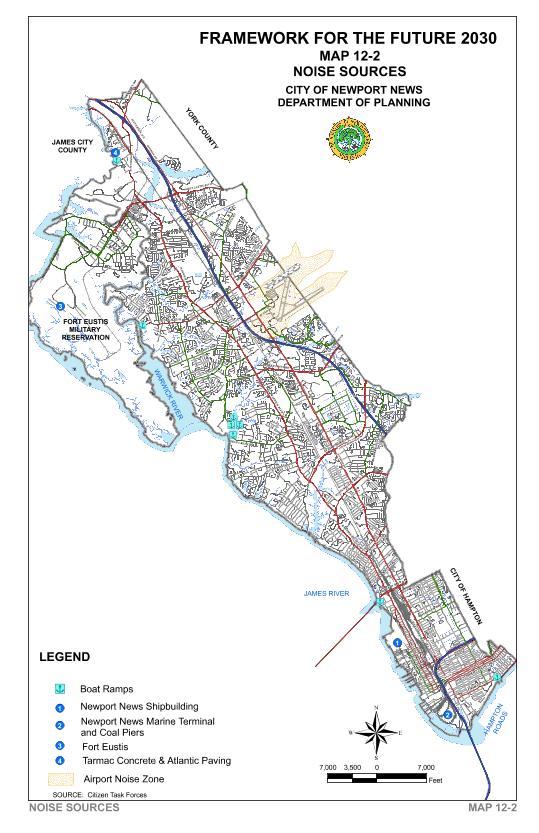
Of major concern to the community are transportation and industrial noise. Major transportation noise sources include Newport
News/ Williamsburg International Airport, Fort Eustis, the CSX railroad, and major streets and highways with an average daily
traffic count (ADT) of 10,000 or greater. Noise sources within the City are identified on Map 12-2. Because noise is capable
of producing both physical and psychological damage, transportation, occupational, and industrial noise sources should be
regulated. To regulate noise there must be a way to measure it and correlate that noise to human annoyance. The most common
form of measurement is the “A-weighted sound level” with zero decibel (dB) being the threshold of hearing. “An average person
considers the loudness of a sound to double if its loudness level is increased by about 10 decibels.” (26) Table 12-2 relates sound levels to different types of sources.
| Perceived Sound Levels | Decibels | Description |
|---|---|---|
| ▲ | 130 | Threshold of pain |
| Deafening | 120 | Jet aircraft take-off at 100 feet |
| ▼ | 110 | Riveting machine at operators position |
| ▲ | 100 | Shot-gun at 200 feet |
| Very Loud | 90 | Bulldozer at 50 feet |
| ▼
▲ |
80 | Diesel locomotive at 300 feet |
| Loud | 70 | Commercial jet aircraft interior in flight |
| ▼
▲ |
60 | Normal conversation speech at 5-10 feet |
| Moderate | 50 | Open office background level |
| ▼ | 40 | Background level within a residence |
| Faint | 30 | Soft whisper at 2 feet |
| Very Faint | 20 | Interior of recording studio |
The City’s noise regulations include a Noise Abatement Policy, which requires either a dense vegetative sound buffer, or a sound wall. The vegetative buffer or sound wall will be required when adjacent to proposed residential development along planned or existing major thoroughfares proposed for improvement (Ordinance No. 4126-90). Also, “ Quiet Zones” can be designated by signs on streets within 300 feet of any churches and hospitals. A "Quiet Zone" around a church is restricted to 11:00 a.m. to 1:00 p.m. and from 7:30 p.m. to 9:00 p.m. on Sundays. (Chapter 38, Article 1,Section 38-14 of the City Code.)