
Our City's Past and Growth
When you have made choice of the river on which you mean to settle...and to the end that you not be surprised as the French in Florida by Molindus and the Spaniard in the same place by the French, you shall do well to make this double provision. First erect a "little stoure" at the mouth of the river that may lodge some ten men, with whom you shall leave a light boat, that when any fleet shall be in sight, they may come with speed to give you warning. (11)
Captain Christopher Newport received this order from the Virginia Company of London before he left England in 1606 to create the first permanent English settlement in the New World. The look out point, which the colonists established at the mouth of the James River, was first identified in 1619 as "Newportes Newes" in English records. (12)
The City was the scene of Revolutionary War and Civil War battles. In 1781, General Benedict Arnold anchored his ships in the lower James River. Lieutenant Banistre Tarleton's cavalry, while obtaining information for Lord Cornwallis, attacked and defeated 400 colonials at the Warwick County Courthouse. On their way to Yorktown, reinforcements for Washington's army and the army under General Lafayette's command rested and obtained water at Endview near Lee Hall.
In 1861, Union General Benjamin Butler secured Newport News for the Union and established Camp Butler. In 1862, off Newport News Point, the Confederate ironclad ship C.S.S. Virginia--previously the Union vessel U.S.S. Merrimack which had been scuttled at Gosport Navy Yard--attacked and sank the U.S.S. Cumberland and the U.S.S. Congress and caused the U.S.S. Minnesota to run aground. On March 9, 1862, the Union ironclad U.S.S. Monitor engaged the C.S.S. Virginia in Hampton Roads. This first battle of ironclad ships ended in a draw. Major General George B. McClellan's Peninsula Campaign resulted in land battles at Young’s Mill and Lee's Mill. Wounded Union soldiers from the fight at Dam No. 1 were carried to Endview. After General Lee's surrender to Grant at Appomattox Court House, Newport News became a place for holding confederate prisoners of war.
In the latter part of the 19th Century, Collis P. Huntington saw the potential of the City's harbor and created the Atlantic deep water terminal of the Chesapeake and Ohio Railway. In 1881 the C& O Railroad was completed to Newport News. Shortly thereafter in 1896, the City with its superior access to water and rail became the location of the Newport News Shipbuilding and Dry Dock Company. In the same year, Newport News was chartered as a municipality. Because of its excellent access to water and rail, the City was a port of embarkation in the Spanish-American War, both World Wars, and the Korean conflict. Wars brought a boom to shipbuilding, military personnel, and growth in the military installations on the Peninsula. World War I also brought the first federally funded planned residential community, Hilton Village.
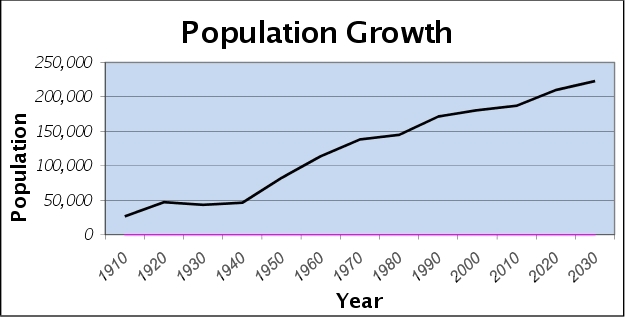
As in World War I, rapid growth came to the City during and after World War II. During the 1940's, the City's population increased 77 percent. In the 1950's, after an attempted five way consolidation failed, Newport News consolidated with Warwick City on July 1, 1958. Because of its consolidation with Warwick City resulting in the acquisition of a large geographic area, Newport News grew to a population of 180,697 on April 1, 2000, according to the U. S. Bureau of the Census. The City's current estimated population is 185,700.
The City is an international seaport located on the world's largest natural harbor. It is home to Northrop Grumman Newport News shipbuilding (NGNN), a manufacturer of great ships, including the S.S. United States, designed by naval architect William Francis Gibbs and once held the Blue Ribbon for the fastest crossing of the Atlantic. NGNN is the only U.S. builder of aircraft carriers.
Following the success of the shipbuilding industry, the City's economy is diversifying into business, technology and scientific research and development, building on Oyster Point of Newport News, the Thomas Jefferson National Accelerator Facility (the Jefferson Lab), the Applied Research Center, and the Virginia Advanced Shipbuilding and Carrier Integration Center (VASCIC).
Recent Growth Trends
During the 1980's, population grew at an average annual rate of 1.6 percent. In the early 1990's population growth slowed to an annual rate below 1%. Forecasts from the Hampton Roads Planning District Commission indicate that the region's population and employment growth will be slower in the future because less military spending and employment reduce per capita income growth; Therefore, diversification becomes more important. Newport News has been working to transform its economic base by attracting new industries, diversifying from defense to science, research, medicine and other forms of high technology. (See Economic Development Chapter)
|
Year |
Population |
% Change |
Growth Influences |
|---|---|---|---|
|
1900 |
24,523 |
n/a |
|
|
1910 |
26,246 |
7.0% |
Natural Growth (1900-1910) |
|
1920 |
47,013 |
79.1% |
World War I (1910-1920) |
|
1930 |
43,246 |
-8.0% |
Naval Disarmament (1920-1930) |
|
1940 |
46,314 |
7.1% |
Depression (1930-1940) |
|
1950 |
82,233 |
77.6% |
World War II (1940-1950) |
|
1960 |
113,662 |
38.2% |
Korean War & Consolidation in 1958 (1950-1960) |
|
1970 |
138,177 |
21.6% |
Viet Nam War (1960-1970) |
|
1980 |
144,903 |
4.9% |
Cold War (1970-1980) |
|
1990 |
171,439 |
18.3% |
Military Buildup (1980-1990) |
|
2000 |
180,697 |
5.4% |
Military Downsizing & Economic Diversification (1990-2000) |
|
2007* |
187,022 |
3.5% |
Military Downsizing (2000-2005) |
| * Planning Department estimates | |||
Over the next 25 years the population is estimated to increase at a decreasing annual rate of 0.63%. If these trends continue, Newport News' population will grow to 215,000 in the year 2030, which reflects a low growth rate. Higher growth rates could place the City's 2030 population above 220,000 people.
Although the Hampton Roads Region has grown since the early 1990s, Newport News, the Region and its other central cities - Norfolk, Portsmouth, Hampton and even Virginia Beach - have experienced out-migration. Within the Region, the population movement continues away from the cities to the fast growing suburbs of Chesapeake, Suffolk, Isle of Wight on the Southside and to James City County, York County, and Gloucester on the Peninsula. However, with the arrival of the Neo-Traditional Developments such as Port Warwick and the mixed use development at City Center there is some in-migration of residents from other localities and other regions within the country.
One key to stable growth is for the City to protect its remaining key sites, e.g., Oyster Point, Oakland Industrial Park, and Patrick Henry Commerce Park, for economic diversification and high quality jobs. Another key is protecting the quality of the City's residential neighborhoods so that Newport News remains a desirable place to live. And where redevelopment is an attractive and logical alternative, the City should encourage the evolution of new housing opportunities to keep communities thriving. Although Newport News has little undeveloped land left to build new housing, the City offers an affordable range of housing in many desirable neighborhoods located close to jobs, shopping, and recreation, all of which are important variables when considering housing location. Consequently, preserving the diversity and continually to improve and enhance the quality of the City's neighborhoods is the City’s principal land use goal.
Growth Rate
There are both benefits and costs associated with growth. Benefits include more jobs that provide higher incomes because of greater financial resources that come with a larger tax base, and the ability to provide quality community services such as schools, parks, libraries, fire and police protection. Costs include more traffic congestion, crime and loss of natural environment and historic sites.
Growth which is too fast or too slow strains the City's resources. Rapid growth puts the City in a catch-up position to build new schools, construct roads and provide facilities and services people want and need to maintain their quality of life. Growth that is very slow hurts the fiscal resources of the City and its ability to provide services. Because large parts of the City's general fund are used for debt service (12 %) or committed to schools (24 %) (13), the resources available for other City services usually must be cut, or the City must raise taxes to balance the budget. Therefore, a moderate population growth rate is financially sustainable and easier to accommodate. Managing growth in the City so that public services and infrastructure can meet its demands is a policy that the citizens support.