Composition of the Economy
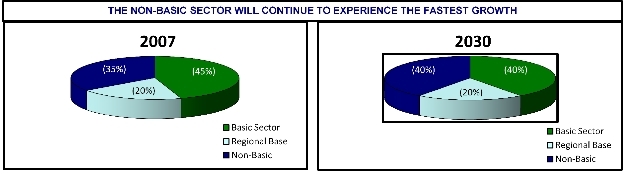
Figure 2-6 shows the projected change between 2007 and 2030 in the basic, regional base and local economic sectors in Newport News. Figure 2-7 shows the projected composition of the Newport News economy in 2030.
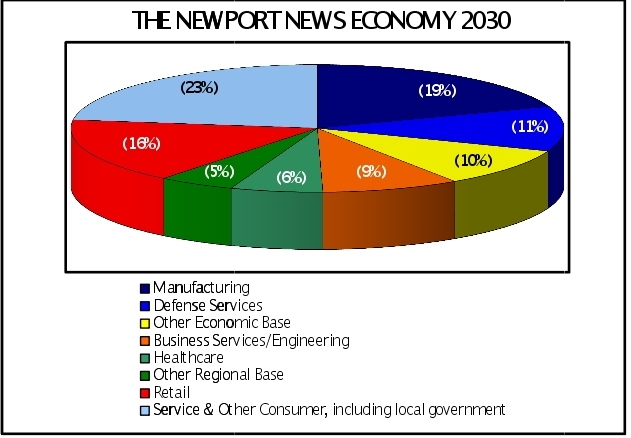
Although new manufacturing firms will have located in Oakland Industrial Park and other areas of the City, including at Canon Virginia, manufacturing employment is expected to decline as a percentage of the total economy. This follows national trends. Manufacturers will substitute capital for labor to remain competitive, whether manufacturers stay close to their markets or if U.S. manufacturing regains strength as global competitive factors become more equalized by 2030.
Regardless of manufacturing trends, the City’ economic base will be increasingly populated by high tech firms, many with research connections to Jefferson Lab, and by corporate and back office operations. Many high tech firms will locate at Jefferson Center for Research and Technology. Growth in corporate and back office employment will occur primarily at City Center and in Oyster Point, at Wolseley North America’s corporate campus, or in the City’s Maritime Center (the City's traditional downtown) and in converted retail properties along Warwick Boulevard. Many existing manufacturers and other light industrial companies may move to Patrick Henry CommerCenter and Camp Morrison or to buildings in Oakland Industrial Park when they become vacant. Others may expand at their current locations.
With the manufacturing sector in flux, it is difficult to predict the make-up of the manufacturing sector in Newport News, beyond the continuing domination of shipbuilding. Plastics, metal fabrication, food processing and advanced materials manufacturing sectors seem to be strong and capable of growth. Canon Virginia should continue to expand and remain strong. Because of the research activities at Jefferson Lab, Newport News could become a center of photonics-related and nanotechnology manufacturing. Other knowledge-based, technologically-driven manufacturing sectors that could expand in the City, including software development, scientific instruments, medical equipment and advanced robotics manufacturing.
There will be a continuing demand for modern distribution warehouses due to the growth of the Hampton Roads ports. Land with access to I-664 and Newport News Marine Terminal could be redeveloped for distribution warehouses. This includes the Harbor Homes and Dickenson Courts housing projects, which are some of the oldest in the region and are negatively impacted by the nearby coal terminals. Land between the CSX railroad and Jefferson Avenue between 39th Street and Mercury Boulevard may be suitable for redevelopment for distribution and light industrial use.
It is becoming increasingly difficult to find sites and buildings for the expansion of existing companies, as well as the attraction of new firms. The declining availability of industrial sites is affecting the City’s ability to maintain a diverse industrial base. Although, some manufacturers have expanded into buildings that are vacant in Oakland Industrial Park, this is a limited resource.
In the near term, the development of Camp Morrison, some sites at Patrick Henry CommerCenter and selective sales of land at Oakland Industrial Park to existing manufacturers can satisfy part of this demand. The private development of Oyster Point West will also accommodate some of this demand for a time. Before 2030, these resources will have been built out. Redevelopment and a selective and appropriate mixing of light industrial and commercial, and even residential uses may provide sites for expanding existing companies.
Office sector growth in Newport News should continue to remain strong, contributing to the City’s economic base and regional base employment. With the location of several corporate headquarters and back office operations, this sector is to become an important part of the City’s economic base. A challenge for the future will be attracting office firms that serve more than a local or regional market.
Two major office centers have emerged in Newport News and should continue to dominate the office sector. The primary center is Oyster Point, which now contains half of the office space on the Peninsula. With the successful development of City Center, Oyster Point has cemented its place as the central business district for the Virginia Peninsula. Continuing high-density, high-quality mixed-use development on land east of City Center, between Canon Boulevard and Rock Landing Drive, will further establish Oyster Point as the Peninsula's office center.
Increasingly, City Center and surrounding development will attract district, regional and primary corporate functions of major national office firms. By 2030, development pressure for denser and higher quality office space will lead to the private sector redevelopment of older properties in Oyster Point. An early example of this trend is the redevelopment of the former Franz Aluminum Building as a new Gold’s Gym. In 2030, Oyster Point will still be the central business district for Newport News.
The second office center is in Downtown Newport News--the Maritime Center. The Maritime Center is home to more than 3,000 Northrop Grumman engineers. City government, the courts and Northrop Grumman Shipbuilding anchor this office employment center. As the Newport News Maritime Center Plan for the Downtown (prepared by LDR International) is realized, the City’s Maritime Center will become more attractive for other special purpose office users. Firms located there are likely to be applications oriented, such as software or engineering firms. As the Maritime Center becomes a mixed-use urban place, with office-serving retail and restaurants and a substantial residential component, it will be more attractive to office users.
Other office sector firms will be located throughout the City at lower densities than in Oyster Point or the Maritime Center. Customer service centers will continue to occupy stand-alone, special-purpose buildings, often converted from former retail uses. Medical offices, small law offices, insurance agents and realtors, will occupy office space in small urban villages that form the core public space of the many neo-traditional neighborhoods scattered throughout the City, including the Southeast Community.
Redevelopment will help ensure continued retail growth through 2030. However, with stores located in the Patrick Henry Corridor spreading to surrounding localities, the Patrick Henry Corridor must keep on the cutting edge of retail trends in order for the City’s retail sector to continue to form part of the regional economic base.
Growth in the local consumer sector will continue to be led by retail and services. This follows the national trend. As the growth curve for the Patrick Henry Retail Corridor peaks and as neighborhood shopping centers and corridors (e.g., the North Denbigh Warwick Boulevard Corridor) are revitalized, retail growth outside of the Patrick Henry Corridor should occur.
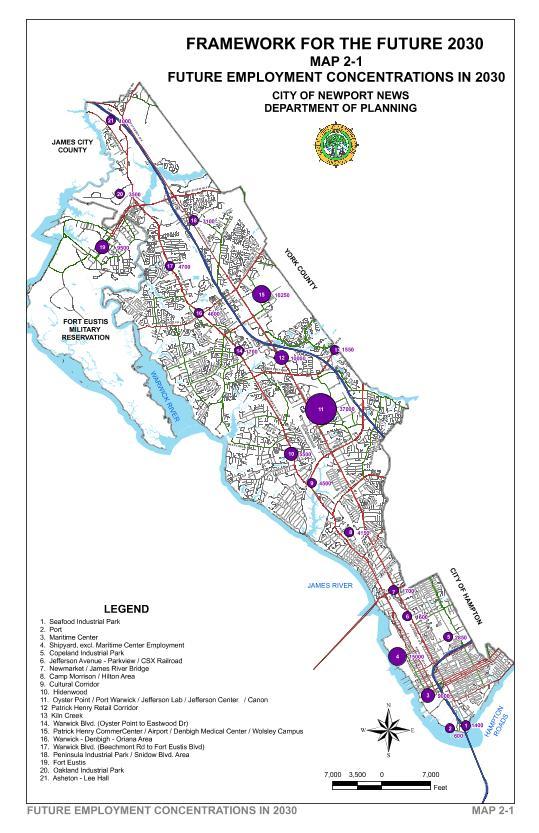
Map 2-1 shows future employment concentrations in the City.