
Economic Development Goals, Policies, Strategies and Implementation Actions
The long-range planning goals for Economic Development are:
- Diversify the City's economy.
- Ensure the availability of a skilled and qualified labor force by directing educational infrastructure and programs to ensure that people are trained for jobs that will be available in the future.
- Increase economic parity between Planning District I, pockets within Planning District III and the rest of the City.
- Improve the City's transportation system as a way to preserve the City's competitiveness for attracting new businesses.
- Provide amenities to help attract new industry, and be selective about the type of industry to improve the City's quality of life.
- Increase the City's tax-base by encouraging long-term, planned tax-revenue producing industrial,commercial and mixed-use new urbanism development through careful, long-term planning of land use.
- Revitalize economically blighted areas of the City and prevent endangered areas from becoming economically blighted.
- Identify the historic and geographic sites essential to preserve the history, beauty, and ecology and enact measures to prevent economic development on them.
The Framework for the Future sets forth the following goals, policies, strategies and implementation for Economic Development:
GOAL 1
Diversify the City's economy.
POLICY 1.1
Strike a balance between actively diversifying the City's economy and guarding against over-development of the City's land.
Strategy 1.1.1 : Take regulatory measures to protect the City's parkland and open spaces.
POLICY 1.2
Encourage development of high technology oriented industry (not to exclude other types of beneficial industry).
Strategy 1.2.1: Aggressively market to clean high-tech firms.
Strategy 1.2.2: Encourage high-tech start-ups.
Strategy 1.2.3: Maintain liaisons with the Thomas Jefferson National Accelerator Facility (Jefferson Lab), Canon Virginia, Northrop Grumman Shipbuilding, Continental AG, the Navy, Fort Eustis and NASA as technology magnets.
Strategy 1.2.4: Develop a philosophy in the City that is supportive and cooperative with business and recognizes opportunity, not just business size.
IMPLEMENTATION 1.2:
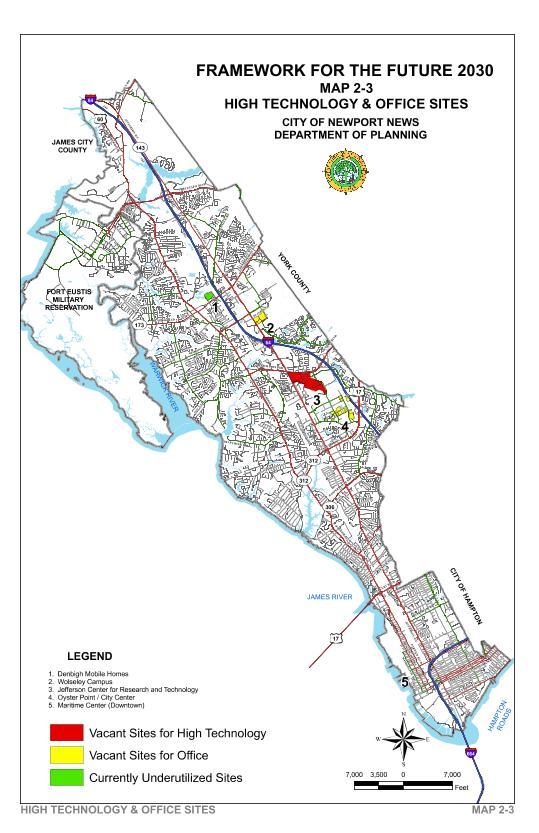
1.2.1: Provide sites at the Jefferson Center for Research and Technology near the Jefferson Lab and throughout the City, where appropriate, for sale to high-technology firms.
1.2.2: Continue to focus media advertising in site selection magazines and direct mail marketing on target high-tech industries.
1.2.3: Seek out and develop new vehicles, both public and private, for venture start-up and financing.
1.2.4: Support a regional business incubator with appropriate entry standards for high-technology small business start-ups, with a target maximum of three years allowed for individual businesses to occupy the site, unless unforeseen circumstances justify an extension.
POLICY 1.3
Encourage the expansion of existing industry and businesses.
Strategy 1.3.1: Maintain cooperation with existing industries and encourage expansion/ diversification through relationship building and through technical and financial assistance programs.
IMPLEMENTATION 1.3:
1.3.1: Continue the City's business visitation program (8)
1.3.2: The Department of Development, through its business retention program, should continue to undertake an ombudsman role and involve other City departments to aid existing businesses in their dealings with City government in order to create a favorable business climate.
1.3.3: Aggressively market and utilize existing fixed-asset loan programs for small- and medium sized-firms.
POLICY 1.4
Encourage the development of small businesses.
Strategy 1.4.1: Maintain appropriately sized and located areas of industrial and commercial zoning to accommodate small businesses.
Strategy 1.4.2: Encourage small light industries in Copeland Industrial Park, and appropriately in other areas of the City.
Strategy 1.4.3: Respond to the economic impacts and opportunities created by our retired and elderly population.
Strategy 1.4.4: .Develop public-private partnership loans to start-up and growing small businesses.
Strategy 1.4.5: Promote the arts as a small business though public participation events (e.g. the Fall Festival).
Strategy 1.4.6: Promote the development of venture capital markets.
Strategy 1.4.7: Leverage the resources of Christopher Newport University (CNU) to support small businesses in the City.
IMPLEMENTATION 1.4:
1.4.1: Institute a policy of "no net loss," over the long run, of commercially or industrially zoned land, meaning that there should be no reduction in total acreage, Citywide, within the commercial or industrial zoning categories.
1.4.2: Preserve adequate amounts of commercially zoned land in all districts of the City to accommodate small business.
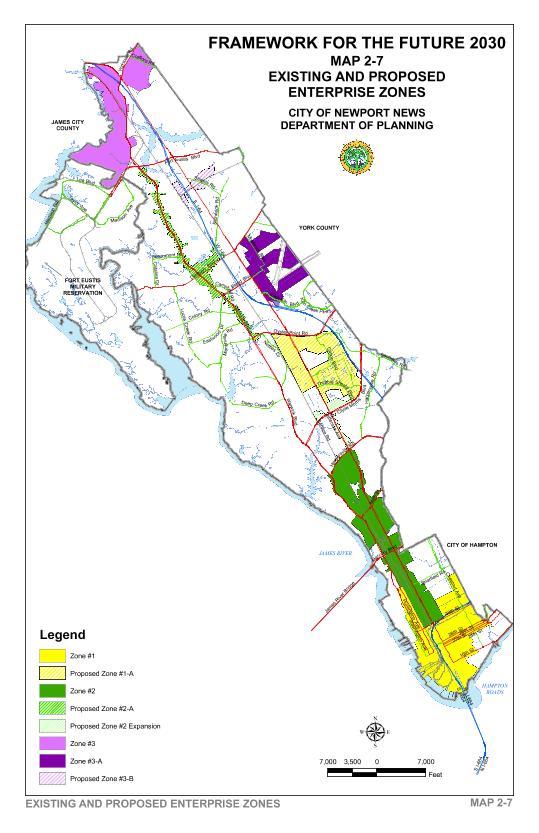
1.4.3: Expand the Newport News Enterprise Zones to their maximum size under existing law.
1.4.4: Identify additional public and private funding sources for loans to start-up firms and micro businesses.
1.4.5: Subject to the availability of suitable developable land, reserve selected land at Patrick Henry CommerCenter for medical-related industry and seek the cooperation of area hospitals in attracting appropriate businesses, consistent with the development of the Patrick Henry CommerCenter within the limitations imposed by the Newport News/Williamsburg International Airport Master Plan.
1.4.6: Determine and take advantage of economic opportunities related to the demands of an increasingly elderly population in areas such as elderly daycare and leisure activities.
1.4.7: Through the business visitation program, link small businesses with the faculty and business consulting resources of CNU
and continue to promote the resources of the Virginia Electronic Commerce Technology Center (VECTEC).
POLICY 1.5
Stimulate export development by local firms.
Strategy 1.5.1: Through the City’s business retention program, continue to work with the Commonwealth to inform local businesses of export
assistance available from state agencies.
Strategy 1.5.2: Attract export-oriented firms from overseas.
Strategy 1.5.3: Work regionally to attract high-caliber manufacturing and office firms to Newport News.
Strategy 1.5.4: Work with and support the efforts of the Hampton Roads Economic Development Alliance, the Virginia Economic Development Partnership and other allies to market Hampton Roads and Virginia in order to attract high-quality companies in targeted industries.
Strategy 1.5.5: Pursue regional cooperation to share the costs of developing business and industrial parks and providing economic incentives to attract new companies to the region.
Strategy 1.5.6: Work with Hampton Roads communities and the Virginia General Assembly to create a legal structure and policies that will
allow communities to share the costs and tax revenues created by major economic development projects that benefit the entire
region.
Strategy 1.5.7: Work with Hampton Roads communities to implement agreed-upon regional economic development projects.
IMPLEMENTATION 1.5:
1.5.1: Aggressively market the City to international firms.
POLICY 1.6
Add to the City's tourist attractions to make Newport News a tourist destination.
Strategy 1.6.1: Promote the City's rich Civil War heritage by creating a Civil War Museum.
Strategy 1.6.2: Continue efforts to clean up the James River and its beaches.
Strategy 1.6.3: Maintain existing beaches, water access and boardwalks, as appropriate.
Strategy 1.6.4: Promote historic districts as points of interest in the City.
Strategy 1.6.5: Promote the City’s shopping, restaurants and tourist attractions in conjunction with the new conference center in City Center at Oyster Point.
POLICY 1.7
Promote tourism throughout the City to increase the City's share of the regional tourism economic base and encourage the development of Newport News as a tourist destination through the development of unique niches in regional tourism market.
Strategy 1.7.1: Ensure that a strong and active tourism office promotes existing Newport News attractions through independent and regional promotional efforts.
Strategy 1.7.2: Exploit the City's proximity to the Historic Triangle of Jamestown, Williamsburg and Yorktown.
Strategy 1.7.4: Encourage the development of Newport News as a tourist destination through the development of unique niches in the regional tourism marker.
IMPLEMENTATION 1.7:
1.7.1: Ensure that the City's tourism office fosters and engages in regional efforts to promote tourism and that existing Newport News' attractions are promoted through such regional efforts.
1.7.2: Promote Newport News attractions as an extension to a Williamsburg or Virginia Beach vacation.
1.7.3: Research the potential feasibility for a National Army History Museum at an appropriate location in northern Newport News.
POLICY 1.8
Encourage the development of new communities that implement the principles of the latest and most efficient city planning highest and best use (currently, “new urbanism”).
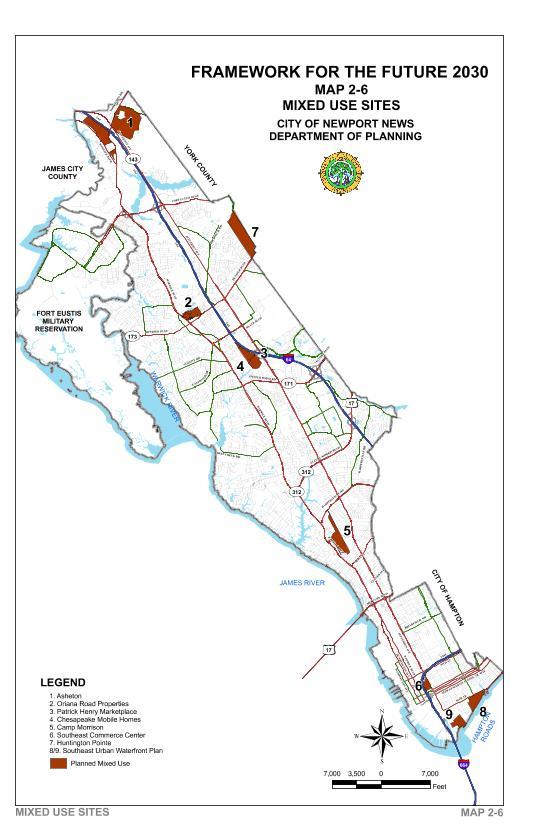
Strategy 1.8.1: Develop appropriate use tools, including zoning overlays, special districts, site plan regulation modification and public-private partnerships, to encourage and allow the private sector to build high-quality, walkable, mixed-use communities, whether through “greenfield” development or redevelopment, throughout the City to reduce suburban sprawl and achieve transportation efficiencies.
IMPLEMENTATION 1.8:
1.8.1: Develop design standards to promote walkability, urban feel and high quality development within Urban Zoning Overlay Districts and continually update these standards as new urbanist design concepts evolve.
1.8.2: Identify opportunities for the redevelopment of obsolete and underutilized properties and districts as new urbanist communities and encourage private sector development of these properties.
GOAL 2
Ensure the availability of a skilled and qualified labor force by directing educational infrastructure and programs to ensure that people are trained for jobs that will be available in the future. (See Education Chapter)
GOAL 3
Increase economic parity(9)between Planning District I, Pockets within Planning District III and the rest of the City.
POLICY 3.1
Attract new businesses to Planning District I and Planning District III.
Strategy 3.1.1: Increase residential and commercial development in Planning Districts I and III through redevelopment plans and programs,
developer assistance, tax increment financing mechanisms, conservation districts and public improvements.
Strategy 3.1.2: Support and expand small business assistance programs and agencies.
Strategy 3.1.3: Provide sites for industrial and commercial firms.
Strategy 3.1.4: Aggressively market properties in Planning District I to prospects.
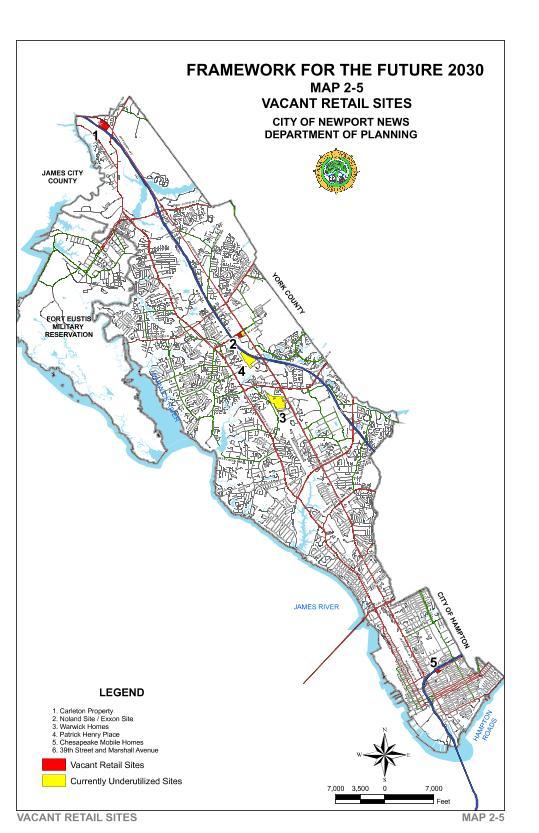
Strategy 3.1.5: Attract grocery-anchored neighborhood shopping centers at appropriate sites within Planning District I.
Strategy 3.1.6: Foster the development and redevelopment of the Southeast Community Urban Waterfront for high-quality, mixed income residential use implementing the principles of new urbanism.
Strategy 3.1.7: Engage Northrop Grumman and the Port in efforts to benefit the Southeast Community.
IMPLEMENTATION 3.1:
3.1.1: Formulate, with community input, a development plan that identifies current business and development opportunities in Planning
District I.
3.1.2: Write down the cost of publicly-owned land in Planning District I to make its price comparable to land prices existing elsewhere
in the City.
3.1.3: Create a commercial conservation district along Jefferson Avenue south of 35th Street. Focus commercial rehabilitation loans, code enforcement, and development review activities in district along Jefferson Avenue south of 36th Street.
3.1.4: Improve the clearinghouse function within City government for small and minority business.
3.1.5: Locate a business incubator in Planning District I.
3.1.6: Continue the model program to foster micro-Business. (10)
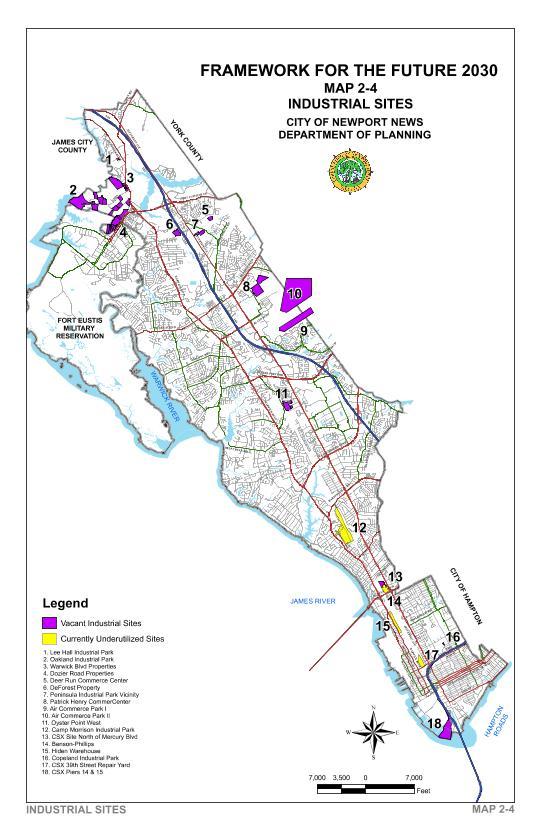
3.1.7: Redevelop suitable land for industrial or commercial use on the CSX property south of Mercury Boulevard, west of Jefferson Avenue between 39th and 72nd Streets, and east of Huntington Avenue between 23rd and 35th Streets.
3.1.8: Continue to identify and aggressively market vacant industrial and commercial property located south of J. Clyde Morris Boulevard, with the specific focus of encouraging only appropriate industry consistent with the adjacent residential uses.
3.1.9: Produce marketing brochures for unique commercial and industrial properties in Planning District I that are under public control.
3.1.10: Develop the Southeast Commerce Center as a mixed use project including a grocery store.
3.1.11: Identify appropriate sites for the development of neighborhood shopping centers south of Mercury Boulevard and encourage private-sector development of these sites.
3.1.12: Complete and implement the Southeast Community Urban Waterfront Plan, taking into consideration citizen input and the needs of existing residents.
3.1.13: Seek partnerships with Northrop Grumman Shipbuilding to encourage subcontractors to locate in the Southeast Community and to foster entrepreneurship in the Southeast Community.
3.1.14: Seek alternative, port-related uses for land in the Southeast Community that is negatively impacted by fugitive coal dust.
POLICY 3.2
Employ a multi-dimensional, coordinated approach to raise income levels within Planning District I.
Strategy 3.2.1: Target education and training funds to at-risk students and those who have already become high school dropouts.
Strategy 3.2.2: Fully utilize existing federal/state grant and loan programs for economic development in Planning District I.
IMPLEMENTATION 3.2:
3.2.1: Establish alternative programs at all grade levels in schools located in Planning District I. These programs should be designed specifically to reduce the dropout rate among urban, disadvantaged youths.
3.2.2: Hire qualified personnel from the Peninsula Work Link program for City jobs.
3.2.3: Establish a grants development center within City government to aggressively seek federal, state and foundation grants to start businesses fight drug abuse, reduce crime, improve health services delivery, prevent domestic violence and child abuse, provide affordable housing, provide more effective income support, improve education and deliver employment training services. The grants development center should closely coordinate with all program implementation agencies.
GOAL 4
Improve the City's transportation system as a way to preserve the City's competitiveness for attracting new businesses. For POLICIES and Strategies, see Transportation chapter.
GOAL 5
Provide amenities and improve the quality of life to help attract new industry while also being selective about the types of industry that the City wishes to attract, so that the new industry will, in turn, improve the City's quality of life. For POLICIES and Strategies see chapters on Land Use, Parks, Recreation, and Tourism, Historic Preservation, and Culture.
GOAL 6
Increase the City's tax-base by encouraging long-term, planned tax-revenue producing industrial,commercial and mixed-use new urbanism development through careful, long-term planning of land use.
POLICY 6.1
Preserve commercial and industrial land for its highest and best use.
Strategy 6.1.1: Extend public control over privately held critical parcels through purchase or development agreement.
Strategy 6.1.2: Carefully control and monitor the zoning of industrial and commercially zoned property to residential use in order to achieve a desired balance of land uses in the City.
IMPLEMENTATION 6.1:
6.1.1: As opportunity and funding allow, acquire key critical sites and parcels for commercial or industrial development or redevelopment by the Economic/Industrial Development Authority of the City of Newport News, Virginia to maximize remaining opportunities for economic diversification, job creation and tax base enhancement.
6.1.2: Negotiate development agreements, where desirable, with owners of critical sites and parcels of 50 acres or more, providing for rights of first refusal, joint development or other mechanisms to ensure that privately owned land is developed to its highest and best use.
6.1.3: Require an opportunity cost analysis when considering the down zoning of industrial and commercially zoned property for residential use.
POLICY 6.2
Ensure that the long-term economic, social and environmental benefits of new development outweigh the costs to the City.
Strategy 6.2.1: Continue to conduct fiscal impact analyses on major projects.
Strategy 6.2.2: While investing in areas of new growth, continue to improve existing areas.
IMPLEMENTATION 6.2:
6.2.1: On commercial and industrial projects which require significant public action or investment, staff recommendations to City Council should continue to be accompanied by a fiscal impact analysis that considers long-term benefits to the City, including taxes, City percentage of jobs and diversification, balanced against short and long-term direct and indirect costs. The complexity of the analysis should be proportional to the City's role in the project and the project's magnitude.
6.2.2: During the capital budget planning cycle, attention should continue to be paid by all City departments to the geographic distribution of capital expenditures.
POLICY 6.3
Promote quality, high end retail development to increase sales tax flow to Newport News.
Strategy 6.3.1: Provide more high end retail shopping opportunities in the City.
Strategy 6.3.2: Improve access and traffic management at retail centers.
Strategy 6.3.3: Control new small parcel strip commercial development and encourage higher density retail centers.
Strategy 6.3.4: Apply more stringent development standards and architectural guidelines to improve the quality of retail centers.
IMPLEMENTATION 6.3:
6.3.1: Develop a demographically-oriented marketing packet to promote the City to retailers. Aggressively market the City to targeted retail firms.
6.3.2: During site plan review, enforce traffic management solutions that will improve access to retail centers.
6.3.3: Encourage proffers from retail developers that help finance traffic management improvements for retail center access.
6.3.4: Where consistent with the Framework for the Future Land Use Plan, expand commercial zoning along arterial streets to depths exceeding 200 feet, thus encouraging development of shopping centers rather than stand-alone storefronts.
6.3.5: Negotiate compliance with more stringent landscape and architectural guidelines when a developer seeks discretionary public approval for retail center development.
6.3.6: Create a retail development coordinator position in the City to work with and assist developers seeking to locate within the City.
6.3.7: Make appropriate public investments, including visual improvements to public rights-of-way, to improve the appearance of the City’s commercial corridors, especially the Upper Warwick Boulevard Commercial Corridor and along Jefferson Avenue south of J. Clyde Morris Boulevard.
6.3.8: Concentrate measures to reduce the amount of commercial strip development and improve the quality of the remaining commercial development on the Upper Warwick Boulevard Commercial Corridor. Encourage a greater mix of compatible uses within the Corridor and along Jefferson Avenue south of J. Clyde Morris Boulevard.
6.3.9: When appropriate, assist private sector developers to attract high-quality retail establishments.
GOAL 7
Carefully plan all industrial and commercial sites to attract new business beneficial to the community.
POLICY 7.1
Develop each City-controlled site to its highest and best use.
Strategy 7.1.1: Complete the development of Oakland Industrial Park as the Peninsula's premier industrial park.
Strategy 7.1.2: Develop the Patrick Henry CommerCenter for light industrial,office, and/or medical-related development. Market the Air Commerce Park for aviation-related uses, avoiding uses that create
excessive noise pollution.
Strategy 7.1.3: Plan and develop the Jefferson Center for Research and Technology for high-tech industry.
IMPLEMENTATION 7.1:
7.1.1: As appropriate and when funds are available, improve access and utilities along Dozier Road.
7.1.2: Evaluate infrastructure development options along the proposed U.S. Route 60 right-of-way.
7.1.3: Evaluate the highest and best use of property in Oakland Industrial Park lying at the end of Enterprise Drive.
7.1.3: Review and amend as necessary the adopted Patrick Henry CommerCenter Plan.
7.1.4: Create and implement a development plan for the Jefferson Center for Research and Technology.
7.1.5: Coordinate with the College of William and Mary on the development of the College's adjoining property as part of Jefferson Center for Research and Technology.
POLICY 7.2
Gain the maximum leverage, while retaining appropriate control over site development, through cooperation with the private sector.
Strategy 7.2.1: Continue to enter into public/private partnerships in the development of industrial, commercial and mixed-use sites.
Strategy 7.2.2: Evaluate alternative public-private cooperation strategies on a case-by-case basis.
IMPLEMENTATION 7.2:
7.2.1: Identify potential sites for public/private partnership development and enter into development negotiations with property owners/developers.
7.2.2: Negotiate quid-pro-quos (instances wherein a developer is required to provide certain specified improvements in exchange for public assistance) related to amenity provision and land use when public assistance is provided to private developers.
7.2.3: Adopt policy guidelines for the evaluation of alternative public/private cooperation strategies.
GOAL 8
Revitalize economically blighted areas of the City and prevent endangered areas from becoming economically blighted.
POLICY 8.1
Redevelop the Downtown in order to continue its transition toward a viable economic base.
Strategy 8.1.1: Establish a strategic plan for the future development of Downtown and prepare a program to carry out the Maritime Center Plan.
Strategy 8.1.2: Provide incentives to developers undertaking projects in redevelopment and renewal areas.
Strategy 8.1.3: Preserve waterfront access at Victory Landing for the citizens of Newport News by expanding Victory Landing Park in the Maritime Center.
Strategy 8.1.4: Promote tourism, especially in connection with the Victory Landing waterfront and the Shipyard.
Strategy 8.1.5: Strengthen citizen involvement in redevelopment planning.
Strategy 8.1.6: Encourage the development of Downtown, by bringing culture, retail and tourist attractions back to the Downtown area.
IMPLEMENTATION 8.1:
8.1.1: Implement the Maritime Center Plan.
8.1.2: Advertise to increase regional awareness of the location advantages of the historic Downtown.
8.1.3: Rehabilitate infrastructure and provide landscaping as a public contribution to private investment.
8.1.4: Fully utilize land assembly and write down, low interest loans, public agency leasing and Enterprise Zone incentives in Downtown public/private partnerships.
8.1.5: Complete improvements associated with the development of a Waterfront Park at Victory Landing.
8.1.6: Maintain and improve public access to the Victory Landing waterfront.
8.1.7: Explore the tourism potential of Downtown attractions on an ongoing basis with tourism officials and representatives of the tourism/travel industry.
8.1.8: Enhance the viability of interstate interchange areas to provide facilities and services to travelers.
POLICY 8.2
Initiate revitalization and redevelopment projects throughout the City.
Strategy 8.2.1: Actively pursue new uses for abandoned buildings.
POLICY 8.3
Redevelop blighted areas in Newport News as economically viable entities.
Strategy 8.3.1: Institute a neighborhood conservation district with new standards that maintain the character of existing neighborhoods, remove blight, and encourage compatible redevelopment.
IMPLEMENTATION 8.3:
8.3.1: Identify cohesive neighborhoods within Newport News and formulate standards for each neighborhood that will best preserve and enhance their unique character.
POLICY 8.4
In accordance with the Land Use Plan, encourage the improvement and revitalization of commercial strip centers in areas in danger of decline.
Strategy 8.4.1: Prevent physical blight and deterioration of commercial strip centers.
Strategy 8.4.2: Offer public incentives to developers and property owners to encourage the restoration, upgrading and beautification of older strip commercial centers.
IMPLEMENTATION 8.4:
8.4.1: Enforce building and zoning codes.
8.4.2: Using the Downtown Facade Program as a model, create a City-wide façade improvement program applicable to older strip shopping centers.
8.4.3: Create a low interest, public/private loan pool to finance renovations of older strip shopping centers.
8.4.4: Ensure that appropriate mixed-use redevelopment of older commercial strip shopping centers is allowed by zoning and site development ordinances.
POLICY 8.5
Develop community standards and ordinances for commercial signage that reduce size, height, density and garish colors of signs.
POLICY 8.6
Revitalization of economically blighted areas should be handled in a manner that improves the water quality of the James River and its tributaries and preserves and protects environmental features intrinsic to water quality, where appropriate.
GOAL 9
Identify the historic and geographic sites essential to preserve the history, beauty, and ecology and enact measures to prevent economic development on them.
- Through the business visitation program, key companies and a sampling of smaller companies periodically meet with the City’s Business Retention Coordinator to discuss any issues or opportunities for the City or other public agencies to assist those companies to thrive and expand in Newport News.
- Economic parity will be achieved when there are no significant concentrations of unemployment and poverty within any Planning District of the City.
- A very small business, employing fewer than five people and often employing only the owner(s)