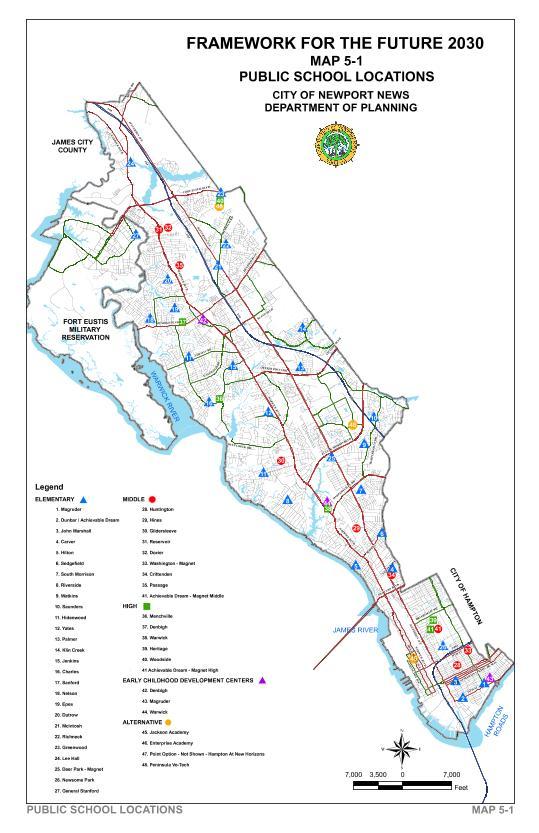
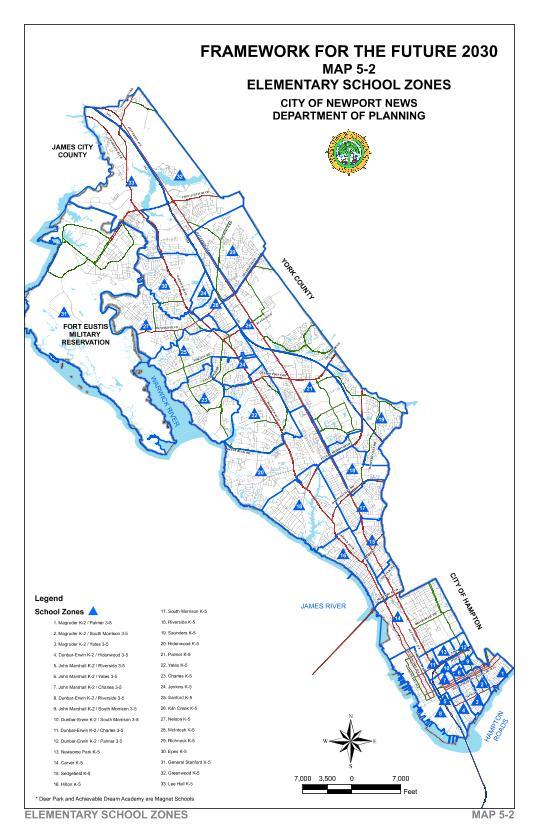
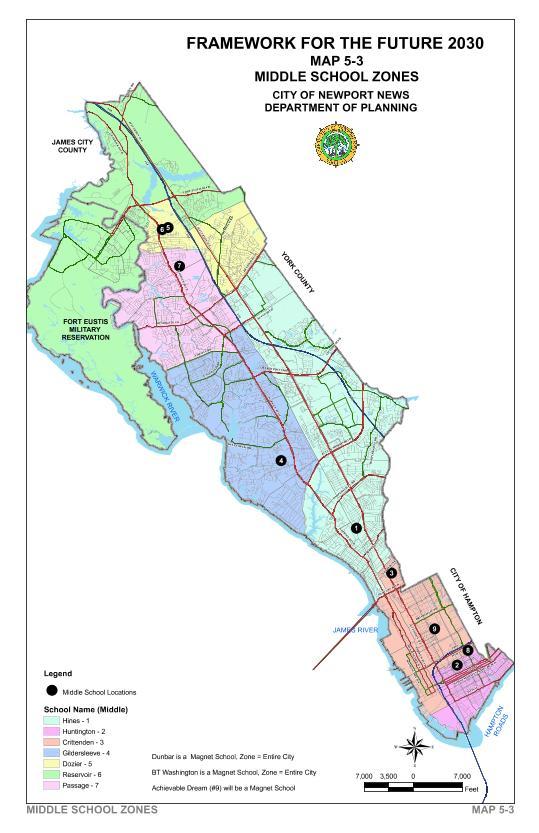
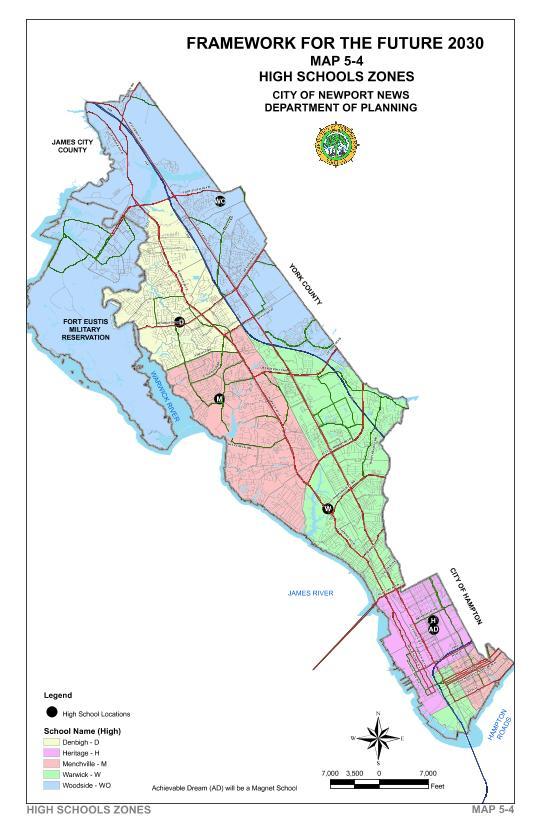
Education Goals, Policies, Strategies and Implementation Actions
The long-range planning goals for Education are:
- Improve academic achievement.
- Establish and maintain safe school climates and facilities.
- Enhance the management, efficiency, effectiveness and accountability of the school division.
- Promote the recruitment, professional development and retention of workforce
- Increase parental, business and public involvement in schools.
- Promote student health.
- Establish school site acquisition/expansion and facilities maintenance program.
The Framework for the Future sets forth the following goals, policies, strategies and implementation for Education.
GOAL 1
Improve academic achievement and close achievement gaps for all public school students .
POLICY 1.1
Increase student mastery of state content standards, annually increase division pass rates on the SOL tests among all students in all ethnic, economic, language and special needs groups, meet the benchmarks for Adequate Yearly Progress in all schools.
Strategy 1.1.1: Develop and implement a school division literacy initiative.
Strategy 1.1.2: Develop and implement a school division math initiative.
Strategy 1.1.3: Implement interventions for all schools and ethnic, economic, language, and special needs students so as to consistently meet the benchmarks for adequate yearly progress.
Strategy 1.1.4: Administer benchmark tests and use their results to assess student's mastery of standards and to prescribe instructional adjustments.
Strategy: 1.1.5: Develop and disseminate division-wide best practices, that define classroom expectations, and institute a plan to monitor their implementation.
Strategy: 1.1.6: Develop and implement a division wide science and innovative solutions initiative.
IMPLEMENTATION 1.1:
1.1.1: Develop and implement literacy improvement plans as part of the Improvement Plan to address identified needs.
1.1.2: Align elementary and middle school math curricula to increase instruction in algebraic concepts in elementary schools.
1.1.3: Provide staff development appropriate for all teachers
1.1.4: Develop and implement a plan to teach study skills as part of the School Improvement Plan in each school.
POLICY 1.2
Increase student achievement in and access to a challenging curriculum. Measure progress by increases in enrollment in and achievement in AP and honors classes, a continuous increases in SAT scores, and a 5% annual increase in students successfully completing Algebra I in the eighth grade.
Strategy 1.2.1: Refine the Talented and Gifted program to increase enrollment and ensure challenging learning experiences.
Strategy 1.2.2: Develop plans to identify of students for enrollment in AP classes and for early introduction of AP readiness skills. Include core curriculum for grades 6-10 to ensure readiness for enrollment in challenging classes.
Strategy 1.2.3: Develop and implement division-wide SAT preparation program.
Strategy 1.2.4: Devise new expectations for the senior year, to include options for dual enrollment, internships, community service, and senior exhibition projects.
IMPLEMENTATION 1.2:
1.2.1: Encourage all students to take PSAT in middle school.
1.2.2: Ensure that all qualified students participate in TAG, AP and/or IB classes.
1.2.3: Develop guidance programs for potential first-generation college students and their parents to outline steps necessary for success in college.
1.2.4: Prepare students with the 21st century skills needed to compete in a global marketplace.
1.2.5: Involve the business community in creating new internship options for students.
POLICY 1.3
Foster consistent and continuous improvement of student achievement by developing and implementing a comprehensive curriculum plan.
Strategy 1.3.1: Develop a comprehensive plan to guide the design, implementation, revision, assessment, and dissemination of the curriculum.
Strategy 1.3.2: Develop and implement written expectations for curriculum monitoring at each school.
Strategy 1.3.3: Increase online computer technology for distance learning, online assessments and data management.
IMPLEMENTATION 1.3:
1.3.1: Continue serving eligible students through the division’s preschool program (first step).
1.3.2: Continue Reading Recovery and Earobics programs.
1.3.3: Implement quarterly interventions based on results of quarterly benchmark tests and develop a systemic approach for targeted interventions.
1.3.4: Develop and implement plans for students with special needs and students with limited English proficiency.
GOAL 2
Establish and maintain school climates and facilities that are safe, orderly, nurturing, and supportive of quality teaching and learning.
POLICY 2.1
Maintain and enhance safe and orderly schools, as measured by student incidents, suspension, and attendance data.
Strategy 2.1.1: Examine data on student discipline in schools and develop prevention/intervention approaches that promote order and safety in schools.
Strategy 2.1.2: Strengthen and implement, alternative education options.
Strategy 2.1.3: Train school division staff in positive student behavior strategies.
Strategy 2.1.4: Enforce truancy laws and develop court interventions for parents who do not support their children's daily attendance.
Strategy 2.1.5: Provide schools with personnel who will not be a threat to the students
IMPLEMENTATION 2.1:
2.1.1: Develop a Crisis Management Plan, to include clearly defined areas of responsibility, command, and control for crisis situations.
2.1.2: Continually evaluate and assess the Crisis Management Plan.
2.1.3: Design and implement interventions and programs to foster citizenship and self-esteem in students who are potential dropouts, long-term suspended or expelled students, or pose a threat to the school and community environment.
2.1.4: Collaborate with social and correctional agencies to develop preventive and support programs to strengthen schools, families and student learning.
2.1.5: Maintain the attendance policy that defines a specific number of absences that cause a student to fail unless the student participates in a redemptive option; provide some exceptional circumstances under which a student may be absent from school when documented as a chronic illness or other documented causes that meet certain board approved criteria.
2.16: Require uniform dress in schools.
2.1.7: Require background checks on all school personnel.
POLICY 2.2
Maintain a supportive and nurturing school climate that fosters equity and positive relationships between and among all ethnic, economic, language, and special needs groups and with staff.
Strategy 2.2.1: Implement strategies that develop positive relationships, social competencies and skills, appreciation for diversity, and empower and engage students in their education.
IMPLEMENTATION 2.2:
2.2.1: Develop roles and responsibilities for students that engage them in their own educational processes, such as volunteer programs, conflict mediation and student anti-violence groups.
POLICY 2.3
Maintain and enhance crisis management safety and security throughout our school division.
Strategy 2.3.1: Implement safety and security measures coordinated by a division Safety and Security Committee to ensure that division and school safety/crisis management procedures exceed federal, state and local standards.
IMPLEMENTATION 2.3:
2.3.1: Continue to implement the Crisis Management Plan.
POLICY 2.4
Assure that all facilities are safe, clean, adequate, and functioning properly to support quality instruction and learning.
Strategy 2.4.1: Assure a healthy and efficient work environment
IMPLEMENTATION 2.4:
2.4.1: Empower students to create and maintain a safe and secure school environment by establishing school safety committees composed of students, teachers, parents and other building staff members.
2.4.2: Conduct yearly safety audits of each building using building-based personnel and make improvements accordingly.
GOAL 3
Provide services to enhance the management, efficiency, effectiveness, and accountability of the school division.
POLICY 3.1
Establish a comprehensive accountability plan to assess effectiveness and efficiency of programs and operations.
Strategy 3.1.1: Establish the capabilities for analyzing and evaluating programs and services.
Strategy 3.1.2: Conduct evaluations of division programs and services for efficiency and effectiveness.
IMPLEMENTATION 3.1:
3.1.1: Develop scheduled monitoring and reporting to assess program effectiveness and service efficiency.
3.1.2: Implement comprehensive accountability plan.
POLICY 3.2
Establish the operational framework for management that promotes accountability.
Strategy 3.2.1: Develop accountability policies and procedures to support the goals of the strategic plan.
Strategy 3.2.2: Incorporate project management practices into the operational framework to enhance effectiveness and efficiency.
IMPLEMENTATION 3.2:
3.2.1: Identify local, state and federal accountability requirements.
3.2.2: Continually evaluate how services and programs affect student achievement.
GOAL 4
Implement policies, procedures, and programs to promote the recruitment, professional development, and retention of a quality workforce.
POLICY 4.1
Meet the division’s human resources needs.
Strategy 4.1.1: Focus the efforts of the human resources department on clearly defined instructional and education support priorities.
Strategy 4.1.2: Provide competitive compensation, benefits and incentives.
Strategy 4.1.3: Implement a performance-based evaluation system for all employees.
IMPLEMENTATION 4.1:
4.1.1: Develop a competitive total compensation package and continue to seek funding to fully implement.
4.1.2: Complete job descriptions for all job titles. Implement annual review of 5% of all job titles each year.
4.1.3: Implement and refine the capability to track personnel needs and specify school assignment for teacher and licensed administrators.
POLICY 4.2
Develop employees for retention and career progression
Strategy 4.2.1: Leverage the resources of the Transition to Teaching (T2T) program to address the division’s staffing needs for highly qualified teachers, and partner with other departments and local colleges and universities to implement Tomorrow’s Teacher’s program.
Strategy 4.2.2: Develop teachers for retention and career progression.
Strategy 4.2.3: Develop educational support personnel for retention and career progression.
Strategy 4.2.4: Develop licensed administrators for career progression.
IMPLEMENTATION 4.2:
4.2.1: Develop and implement a recruitment and retention plan.
4.2.2: Continue implementation of the Transition to Teaching program to address the division’s staffing needs for highly qualified teachers.
4.2.3: Recruit qualified NNPS teachers interested in pursuing National Board Certification.
PARENTAL, BUSINESS, AND PUBLIC INVOLVEMENT
The Framework for the Future sets forth the following goal, policy, strategies and implementation for Parental, Business, and Public Involvement.
GOAL 5
Increase parental, business, and public involvement in schools through the development of a community information, education and involvement program.
POLICY 5.1
Improve communication and coordination between home and school.
Strategy 5.1.1: Continue to develop additional ways of communicating with parents, such as scheduling special events, weekly newsletters, Internet, items in the local neighbors section of the paper, television and recognizing parents who volunteer or do something special for the school.
Strategy 5.1.2: Develop positive relationships with parents or guardians.
Strategy 5.1.3: Develop effective methods to solicit feedback from the community.
IMPLEMENTATION 5.1:
5.1.1: Develop checklist/survey for schools, central office departments and community to determine modes, methods and frequency of communication with parents and community.
5.1.2: Develop checklist/survey for NNPS staff to determine modes, methods and frequency of communication.
5.1.3: Analyze all survey data and prepare a division wide communications plan.
5.1.4: Implement the communications plan and revise as needed.
POLICY 5.2
Develop initiatives to strengthen and increase community involvement in the education of all students.
Strategy 5.2.1: Encourage parents and civic organizations to support and sponsor after-school programs.
Strategy 5.2.2: Integrate, promote and enhance PTA involvement in the school division.
Strategy 5.2.3: The school system should develop programs in partnership with parents and the parent-teacher association to evaluate the responsibilities of each toward the students. Support and promote positive parenting.
Strategy 5.2.4: Motivate positive family involvement with schools by welcoming in-school parental visits and encouraging teachers to spend more time meeting with parents.
IMPLEMENTATION 5.2:
5.2.1: Encourage additional support for teachers through use of “community volunteers.”
5.2.2: Enlist volunteers as tutors and role models.
5.2.3: Develop a plan to recruit, train and retain volunteers
5.2.4: Increase opportunities for community involvement in student achievement.
5.2.5: Emphasize more PTA participation.
POLICY 5.3
Increase interrelationships between the school system and the business community.
Strategy 5.3.1: Continue developing specialized education, internship and apprentice programs to meet projected labor needs.
Strategy 5.3.2: Increase opportunities for business and community involvement.
Strategy 5.3.3: Support a voluntary, coordinated local and regional effort for the development and implementation of programs involving businesses and educational institutions in a cooperative effort to improve education and training.
Strategy 5.3.4: Expand opportunities for service projects and enrichment programs for students and staff.
Strategy 5.3.5: Encourage employers to facilitate employee involvement in the education of their children.
IMPLEMENTATION 5.3:
5.3.1: Vigorously continue to increase the range of technically oriented businesses participating in business partnerships with the schools to sponsor students in a variety of on-the-job training/learning programs.
5.3.2: Use government research regarding current and projected labor needs in planning for schools.
5.3.3: Promote and publicize the Educational Foundation activities and internship programs such as: School to Work Coordinating Council, Newport News Public Schools Vocational Advisory Council, BIG-MAC and NNPS Business-Education Partnership Programs.
5.3.4: Increase support for a Business Partner Coordinator at each school to maintain business partner contacts.
5.3.5: Expand opportunities for community involvement in career education.
5.3.6: Develop educational materials and seminars for corporate executives and supervisory staff of area businesses and industry that stress the importance of releasing employees to attend important functions and meetings at their children’s schools.
POLICY 5.4
Increase awareness of school programs and opportunities for public participation.
Strategy 5.4.1: Utilize a variety of forms of advertisement to publicize School Board meetings, school plans, performance statistics and PTA meetings in order to encourage participation from all citizens, not solely parents with students currently in the public school system.
Strategy 5.4.2: Encourage attendance from all citizens at school related events.
Strategy 5.4.3: Establish a program through the Chamber of Commerce and other business forums to sponsor brochures on public education for distribution to the general public.
Strategy 5.4.4: Continue to publicize schools’ performance data through a comprehensive and far-reaching publicity program to include the local press and educational cable channels and the Internet.
Strategy 5.4.5: Continue the development of school profiles for distribution to the public that include standardized test scores, graduation and attendance rates, course enrollments, awards, population characteristics and other data.
Strategy 5.4.6: Maintain a public relations program that improves the perception of the NNPS division by providing a mechanism to get information to the public.
IMPLEMENTATION 5.4:
5.4.1: Continue to televise School Board meetings and PTA meetings on the public cable channels and disseminate information regarding actions and intentions. (See also Chapter 13, Urban Services)
5.4.2: Continue to publicize schedules of all school related events.
5.4.3: Continue to rotate the location for School Board town meetings to make them accessible to all citizens. Hold PTA meetings at alternate locations to allow access for all parents.
GOAL 6
Actively pursue policies, programs, and procedures that preserve, sustain, and promote student health.
POLICY 6.1
Ensure the physical health of all children in the public schools.
Strategy 6.2.1: Develop a health supervision program to insure that all students meet minimum health standards.
Strategy 6.2.2: Provide medical and dental checkups for children six to twelve years of age.
Strategy 6.2.3: Require medical examination and shot updates for students when entering elementary school, middle school and high school.
Strategy 6.2.4: Encourage good eating habits to reduce teenage obesity and its corresponding health issues.
IMPLEMENTATION 6.2:
6.2.1: Lobby the state legislature to require health examinations for students entering elementary school, middle school and high school.
6.2.2: Lobby the state legislature and other budgetary sources to increase the preventive health care opportunities in the schools.
6.2.3: Offer well balanced reduced fat lunches and fruit in school cafeterias.
6.3.4: Remove vending machines from schools that sell sugary drinks and fatty foods.
POLICY 6.3
Ensure the physical fitness of all students.
Strategy 6.3.1: Make physical education part of the curriculum by requiring athletics and physical education for all students in grades K-12.
Strategy 6.3.2: Require students to participate in a physical education program a minimum of three times a week in all grades.
Strategy 6.3.3: Develop centrally located athletic fields in the City which are accessible to all students.
IMPLEMENTATION 6.3:
6.3.1: Ask the school board to implement programs to ensure that all students are physically fit.
6.3.2: Lengthen the school day by adding an extra period and devote at least three days to physical education.
6.3.3: Continue to allow participation in Junior Varsity and Varsity sports to substitute for the required physical education course.
6.3.4: Budget funds to acquire and develop large, centrally located athletic fields.
6.3.5: Request the State Board of Education to develop SOLs for physical fitness.
POLICY 6.4
Provide students access to a family life program.
Strategy 6.4.1: Continue to support the Newport News school's family life program.
Strategy 6.4.2: Ensure the program contains educational material that will encourage abstinence, reduce teen pregnancy and reduce the rate of STDs amongst teens.
IMPLEMENTATION 6.4:
6.4.1: Constantly evaluate the Newport News school's family life program.
GOAL 7
Establish a school site acquisition/expansion and facilities maintenance program.
POLICY 7.1
Provide adequate facilities for projected future school needs and ensure that existing facilities are well maintained.
Strategy 7.1.1: Continually forecast future student enrollment and evaluate existing facilities develop expansion plans and capitol programs to meet projected needs for new schools.
Strategy 7.1.2: Constantly evaluate school facilities to ensure proper maintenance and upkeep.
Strategy 7.1.3: Reserve and protect sites for future schools.
Strategy 7.1.4: Build facilities to eliminate the need for relocatable classrooms.
IMPLEMENTATION 7.1:
7.1.1: The City should lobby the General Assembly to enact legislation that would require developers of large tracts of residential land to pay impact fees or reserve land for school development.
7.1.2: Develop strategies to assess, on a continuing basis, the curb appeal of school buildings and the best utilization of resources for physical improvements to facilities.
7.1.3: Support the School Board's strategic plan in conjunction with the Framework for the Future Plan for education which would establish the City's long term goals regarding school acreage, space standards, potential and efficiency of existing facilities, long range educational needs, student enrollment, facility expansion and facility location. Include representatives from school-based staff, central administration, and support services in planning the design of a new school or major school renovation.
7.1.4: Rehabilitate and maintain schools and lobby the State to develop and refine alternative methods to raise money for repairing schools.
7.1.5: Acquire and pursue future school sites for Asheton and Huntington Pointe
GOAL 8
In accordance with federal mandate, minimize court approved busing and achieve integrated schools.
POLICY 8.1
Develop quality neighborhood elementary schools and improve programs throughout the city
Strategy 8.1.1: Encourage integration of neighborhoods by establishing and maintaining quality schools throughout the City to reduce the need to bus school-age children.
Strategy 8.1.2: Allow community involvement in the formation of school attendance zones and student selection procedures for magnet programs.
Strategy 8.1.3: Continue to develop and refine magnet programs to achieve diversity in schools.
IMPLEMENTATION 8.1:
8.1.1: Strive to reduce bus rides to a maximum of 30 minutes for students attending schools within an attendance zone.